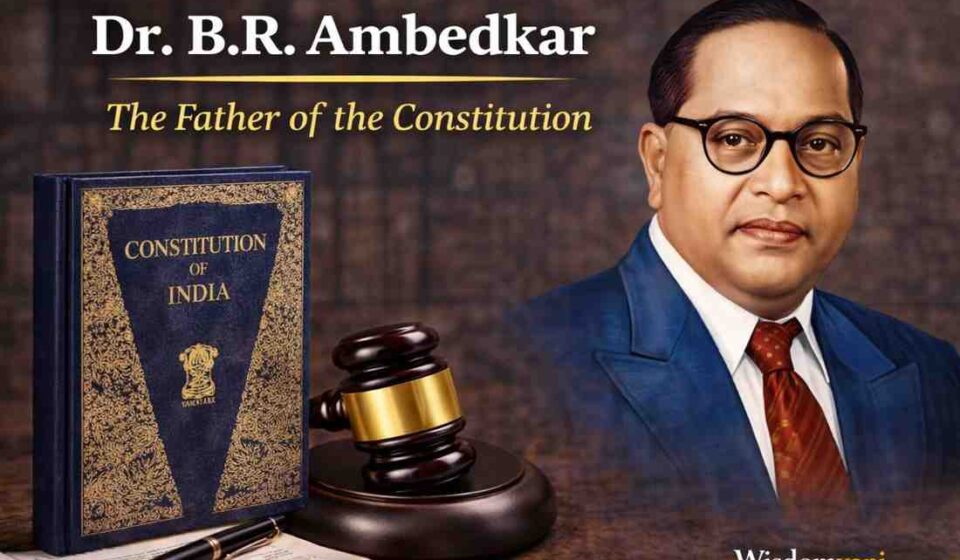

On the 14th of April, India stops to honor a man whose life was a journey from the very bottom of a rigid social hierarchy to the absolute highest office of the land. Dr. Bhimrao Ramji Ambedkar, or Babasaheb, is celebrated today not just as a leader of the Dalit community, but as the principal architect of the Indian Republic. His story is one of the most remarkable intellectual and social odysseys in human history—a story of how a boy who was once denied a drink of water from a common tap grew up to write the laws that would protect every citizen’s right to dignity.
The Roots of Resistance: Childhood and the “Gunny Bag”
The story begins in 1891 in the military cantonment of Mhow. Bhimrao was the fourteenth child of Ramji Maloji Sakpal, a Subedar in the Indian Army, and Bhimabai. Despite his father’s respected military rank, the family belonged to the Mahar caste, which the social order of the time branded as “untouchable.”
As a child, Bhimrao experienced the psychological violence of caste every day. In school, teachers refused to touch his notebooks, and he was forced to sit on a gunny bag that he had to bring from home and take back every day—because even the floor was considered “polluted” by his presence. The most haunting memory of his school days, which he later wrote about in Waiting for a Visa, was the “no peon, no water” reality. He was not allowed to touch the water tap; he had to wait for the school peon to pour water from a height into his hands. If the peon was absent, Bhimrao went thirsty for the entire day.
These were not just childhood hardships; they were the seeds of a lifelong legal battle. He realized early on that kindness from upper castes was temporary, but legal rights were permanent. This realization pushed him to become the first matriculate in his community in 1907, an event so celebrated that it caught the attention of the Maharaja of Baroda, who would eventually fund his higher education.
The Intellectual Odyssey: A Scholar of Global Repute
Dr. Ambedkar’s academic credentials remain unmatched. He didn’t just study for degrees; he studied to understand how power works. Supported by the Maharaja of Baroda, he traveled to Columbia University in New York, where he earned his M.A. and Ph.D. It was here that he met the great philosopher John Dewey, who taught him that democracy is not just a form of government but a “social contract” and a way of life.
| Degree | Institution | Focus |
| B.A. | Bombay University | Economics & Political Science |
| M.A. | Columbia University | Ancient Indian Commerce |
| Ph.D. | Columbia University | National Dividend of India |
| M.Sc. | London School of Economics | Provincial Decentralization |
| D.Sc. | London School of Economics | The Problem of the Rupee |
| Barrister-at-Law | Gray’s Inn, London | Legal Training |
His time at the London School of Economics (LSE) was a period of extreme frugality. To save money for books, he often skipped lunch and lived on a diet of tea and biscuits. His doctoral thesis, The Problem of the Rupee (1923), was a direct critique of British colonial exchange policies. This work was so foundational that when the Hilton Young Commission came to India to discuss a central bank, every member had a copy of his book. This eventually led to the creation of the Reserve Bank of India (RBI) in 1935.
The “Poor Man’s Barrister” and Landmark Legal Battles
When Ambedkar returned to India, even his world-class doctorates couldn’t protect him from caste. When he started his practice at the Bombay High Court in 1923, he was initially ignored by solicitors and clients alike. But he soon built a reputation as the “poor man’s barrister,” often representing the marginalized for little to no fee.
One of his most significant early legal victories was the Phillip Spratt Case (1927). Spratt, a British communist, was charged with sedition for a pamphlet. Ambedkar, as a junior counsel, helped argue that criticizing British imperialism was not the same as an attack on the government of India. He also famously defended the publisher of the book Deshache Dushman against defamation charges, successfully arguing that criticizing public figures for their ideas was a protected right.
But his legal heart was always with social justice. In the Chavdar Tank Case, he spent ten years in a legal battle after his 1927 Satyagraha in Mahad. Caste Hindus claimed the water tank was private property to keep Dalits away. Ambedkar argued it was a public resource maintained by municipal funds. In 1937, the Bombay High Court finally ruled in his favor, a landmark victory for civil rights in India.
The Social Revolutionary: Water and Worship
Dr. Ambedkar knew that legal battles needed to be backed by social agitation. Two movements define this era of his life:
- Mahad Satyagraha (1927): This wasn’t just about water; it was about the right to be human. When he led thousands to drink water from the Chavdar tank, he said, “We are not here to drink water, we are here to assert our right to live as human beings.” Following this, he symbolically burned the Manusmriti on December 25, 1927, rejecting the legal code that sanctioned the slavery of his people.
- Kalaram Temple Entry (1930): For five years, Ambedkar led a non-violent struggle for the right to enter the Kalaram temple in Nashik. He argued that if a man can enter a court of law, he must be allowed into a house of God. While the movement faced fierce opposition, it successfully forced the nation to confront the ugliness of untouchability.
Architect of the Working Class: Labor Reforms
Many people forget that Ambedkar was one of India’s greatest labor leaders. As the Labor Member of the Viceroy’s Executive Council (1942–46), he fundamentally changed the life of the Indian worker.
He was the man who reduced working hours from 14 hours to 8 hours a day. He introduced the concept of “Tripartism,” where workers, employers, and the government sit at the same table to resolve disputes. His contribution to women in the workforce was pioneering; he drafted the Mines Maternity Benefit Act, ensuring that mothers received rest and financial security. He believed that labor is not a commodity, and his “Labor Charter” of 1945 remains a blueprint for workers’ rights even today.
Father of the Constitution: Drafting the Destiny of a Nation
After Independence, Prime Minister Nehru invited Ambedkar to be the first Law Minister of India. Soon after, he was appointed Chairman of the Drafting Committee of the Constituent Assembly. For 167 days, he steered the drafting process, answering every doubt and defending every clause with logic and historical depth.
He didn’t just want a legal document; he wanted a “vehicle of life.”
- Article 17: He ensured that “Untouchability” was not just discouraged but legally abolished.
- Article 32: He called the “Right to Constitutional Remedies” the “soul of the Constitution,” because a right without a remedy is no right at all.
- Social Democracy: In his final speech to the Assembly, he warned that political democracy (one man, one vote) would collapse if India did not achieve social democracy (one man, one value).
He introduced the concept of “Constitutional Morality,” arguing that the spirit of the Constitution must be lived by the people and the government, not just written on paper.
The Feminist Jurist and the Hindu Code Bill
Ambedkar’s vision for equality was incomplete without the liberation of women. He famously said, “I measure the progress of a community by the degree of progress which women have achieved.”
As Law Minister, he drafted the Hindu Code Bill to modernize and unify Hindu personal law. His proposals were revolutionary:
- Giving daughters an equal share in inheritance.
- Enforcing monogamy and providing the legal right to divorce.
- Giving women the right to property and guardianship of children.
The Bill faced vicious opposition from orthodox groups who called him a “modern Manu.” When the Bill was stalled by his own cabinet colleagues, Ambedkar did something few politicians do—he resigned in 1951, proving that his commitment to women’s rights was more important than his ministerial chair.
The Final Transition: Seeking Spiritual Equality
By the 1950s, Ambedkar realized that social change required a moral foundation that the caste system would never allow. In 1935, he had vowed, “I was born a Hindu, but I will not die a Hindu.” After decades of study, he chose Buddhism for its emphasis on reason, compassion, and equality.
On October 14, 1956, at Deekshabhoomi in Nagpur, he embraced Buddhism with nearly 500,000 followers, sparking a massive movement for spiritual and social liberation. He passed away peacefully on December 6, 1956, just weeks after completing his final book, The Buddha and His Dhamma.
Conclusion: An Enduring Legacy
Dr. B.R. Ambedkar was a man who fought on all fronts: in the classroom, in the courtroom, on the streets, and in the Parliament. He taught us that “lost rights are never regained by appeals to the conscience of the usurpers, but by relentless struggle.”
His legacy is not just in the statues we see or the Jayanti we celebrate; it is in every woman who inherits property, every worker who leaves the office after 8 hours, and every citizen who stands before a court to demand their fundamental rights. On this Ambedkar Jayanti, we honor the man who turned a “life of contradictions” into a blueprint for a just and equal India.