
Fundamental Rights under the Indian Constitution: Articles, Meaning, and Exceptions

Imagine waking up one morning and finding out that the police arrested your neighbour overnight — no charges, no court, no explanation. Or that a school down the road refused to admit a child simply because of her religion. Or that a newspaper was shut…
Powers and Functions of the President of India: The Guardian of the Constitution
When we think of the President of India, the image that often comes to mind is someone standing tall on Republic Day, saluting the armed forces, or addressing the nation on important occasions. But behind the ceremonial dignity lies one of the most…
What Are Writs? Types, Uses, and How They Protect Your Legal Rights
Imagine you’re wrongfully detained, or a government official refuses to do their job, or a lower court steps way out of line. In a system that values justice, you need a fast, powerful way to push back. That’s where writs come in. These…
Article 368 of the Indian Constitution: Procedure and Power of Parliament to Amend
The Indian Constitution is often described as a “living document,” a metaphorical designation that underscores its organic capacity to evolve alongside the socio-political and economic aspirations of the nation. At the heart of this…
Separation of Powers: Doctrine, Meaning, Case Laws and Critical Analysis in India
Introduction Every modern democracy faces one fundamental challenge: how to prevent any single branch of government from becoming too powerful. The answer lies in the Separation of Powers doctrine. It is one of the most important principles that shapes…
The Doctrine of Parens Patriae in India: Understanding State Guardianship
Imagine a child left without parents, a person with severe mental illness unable to make decisions, or a community facing an environmental disaster. Who steps in to protect their interests? In many legal systems, including India’s, the answer lies in an…

Freedom of Speech and Expression: Article 19(1)(a) and Reasonable Restrictions
1. Introduction Think about this for a moment. Without the freedom to speak, how would you protest a government policy you believe is unjust? Without the freedom to write, how would journalists expose corruption? Without the freedom to express, how…
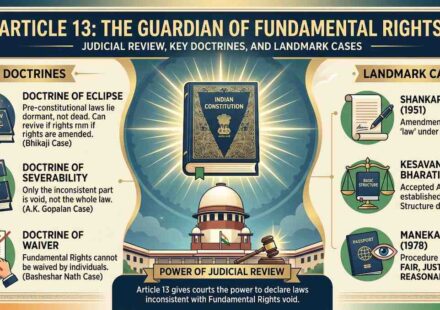
Article 13 of the Indian Constitution: Shield of Fundamental Rights & Judicial Review
1. Introduction — A Small Article with an Enormous Job Somewhere in the very beginning of Part III of the Constitution of India — the chapter that houses our Fundamental Rights — sits Article 13. It is not the most dramatic article. It does not declare…
The Amendment of the Indian Constitution
1. Introduction — A Constitution That Must Live and Breathe Imagine writing a set of rules in 1950 to govern a country of 350 million people — rules meant to last not just for that generation, but for every generation that follows. How do you write…