Skip to content
Wisdomvani Wisdomvani

law

Wisdomvani Wisdomvani

law

  • Home
  • Law Study Material
    • Jurisprudence
    • Constitutional Law
    • Law of Contract
    • Company Law
    • Labour Law
    • Media Law
    • Hindu Law
    • Muslim Law
    • CPC
    • Criminal Law
    • International Business Law
  • PYQ
    • BA LLB
  • Question Bank
  • Judgements
    • Supreme Court
    • High Court
  • Legal Drafting
  • Home
  • Law Study Material
    • Jurisprudence
    • Constitutional Law
    • Law of Contract
    • Company Law
    • Labour Law
    • Media Law
    • Hindu Law
    • Muslim Law
    • CPC
    • Criminal Law
    • International Business Law
  • PYQ
    • BA LLB
  • Question Bank
  • Judgements
    • Supreme Court
    • High Court
  • Legal Drafting
Close

Search

Trending Now:
5 Essential Tools Every Blogger Should Use Music Trends That Will Dominate This Year ChatGPT prompts – AI content & image creation trend Ghibli trend – viral anime-style visual trend
Wisdomvani Wisdomvani

law

Wisdomvani Wisdomvani

law

  • Home
  • Law Study Material
    • Jurisprudence
    • Constitutional Law
    • Law of Contract
    • Company Law
    • Labour Law
    • Media Law
    • Hindu Law
    • Muslim Law
    • CPC
    • Criminal Law
    • International Business Law
  • PYQ
    • BA LLB
  • Question Bank
  • Judgements
    • Supreme Court
    • High Court
  • Legal Drafting
  • Home
  • Law Study Material
    • Jurisprudence
    • Constitutional Law
    • Law of Contract
    • Company Law
    • Labour Law
    • Media Law
    • Hindu Law
    • Muslim Law
    • CPC
    • Criminal Law
    • International Business Law
  • PYQ
    • BA LLB
  • Question Bank
  • Judgements
    • Supreme Court
    • High Court
  • Legal Drafting
Close

Search

Trending Now:
5 Essential Tools Every Blogger Should Use Music Trends That Will Dominate This Year ChatGPT prompts – AI content & image creation trend Ghibli trend – viral anime-style visual trend
Home/Blog/Why MP High Court Rejected Pen Drive Evidence in Malini Jain Case
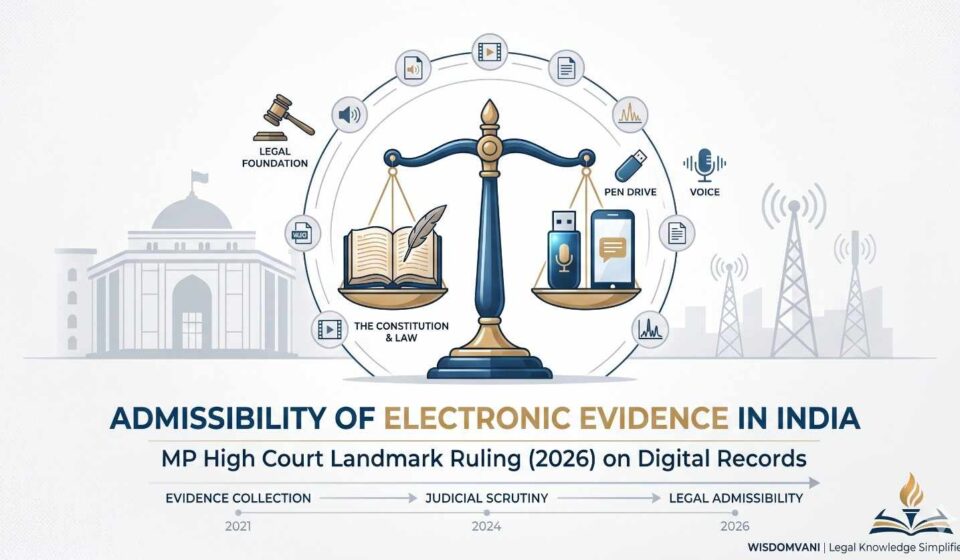
Admissibility of Electronic Evidence in India: MP High Court 2026 Ruling on Pen Drive and Section 63 BSA WisdomVani.
BlogHigh Court

Why MP High Court Rejected Pen Drive Evidence in Malini Jain Case

By Swati Bhardwaj
February 16, 2026 3 Min Read
0

In the digital age, audio and video recordings are often seen as “smoking guns” in legal battles. However, a recent landmark judgment by the Madhya Pradesh High Court serves as a crucial reminder: Electronic evidence is only as good as its legal foundation.

In the case of Malini Jain v. Pankaj Bhutad and Others (February 6, 2026), the Court clarified why simply handing over a pen drive is insufficient for it to be accepted as legal proof.

The Case Background: Malini Jain v. Pankaj Bhutad

The case originated from an FIR filed in 2021 involving allegations of forgery (Sections 420, 467, 468, and 471 of the IPC). The petitioner, Malini Jain, alleged that medical records were forged to cover up negligence during her husband’s treatment.

To support her claim, she sought to submit a pen drive containing voice recordings of her late husband. The Trial Court rejected the application, leading to a challenge in the High Court.

Why the High Court Rejected the Pen Drive Evidence

Justice B.P. Sharma upheld the rejection, highlighting three critical legal pillars that every litigant must understand:

1. The Challenge of Voice Identification

The Court observed that there was no “accepted and definite evidence” to identify the voice in the recording.

  • Legal Rule: For an audio recording to be admissible, the prosecution or petitioner must prove beyond doubt that the voice belongs to the person claimed. Without a Forensic Science Laboratory (FSL) report or spectrography test, a recording remains mere “noise” in the eyes of the law.

2. Legal Relevance vs. General Allegations

A significant reason for the rejection was the mismatch between the charges and the evidence.

  • The Mismatch: The accused were charged with forgery and cheating. The recordings, however, allegedly discussed medical negligence.
  • The Court’s View: Evidence must be strictly relevant to the specific charges framed. Material pointing toward negligence cannot automatically be used to prove a charge of document forgery.

3. Unexplained Delay and Credibility

The incident occurred in April 2021, but the pen drive was only brought forward in July 2024.

  • The “Silence” Factor: The Court noted that the existence of these recordings was never mentioned during the initial police investigation or in statements recorded under Section 161 CrPC. This three-year delay cast a shadow of doubt on the authenticity of the device.

The Necessity of Section 63 BSA (Formerly Section 65B)

Under the new Bharatiya Sakshya Adhiniyam (BSA), 2023, specifically Section 63, electronic records are classified as secondary evidence. To make them admissible, you must provide a certificate that:

  1. Identifies the electronic record.
  2. Describes the manner in which it was produced.
  3. Confirms that the device was operating properly and the data has not been tampered with.

How to Ensure Your Digital Evidence Stands in Court

To ensure that digital evidence like a pen drive is accepted in an Indian Court, the following steps are vital:

  • Immediate Disclosure: Mention the existence of the recording at the earliest possible stage (e.g., in the FIR or initial statements).
  • Maintain Chain of Custody: Ensure the original device (the phone or recorder used) is preserved and its “Hash Value” is recorded.
  • Procedural Compliance: Always file the mandatory certificate under Section 63 of the BSA (or Section 65B of the Evidence Act for older cases).
  • Expert Verification: Seek voice or image identification through authorized forensic experts.

Conclusion

The MP High Court’s ruling in the Malini Jain case reinforces that procedural integrity is non-negotiable. A pen drive is a vulnerable medium, susceptible to tampering and editing. Until the law is satisfied with its origin and relevance, it will remain outside the courtroom doors.


Tags:

Digital Evidence Certificate IndiaElectronic Evidence AdmissibilityMP High Court Judgments 2026Section 63 BSA 2023Voice Recording Evidence Law
Author

Swati Bhardwaj

Follow Me
Other Articles
Delhi High Court Landmark Ruling on POCSO Act and Teenage Romance Bail WisdomVani.
Previous

POCSO Act and Teenage Romance: Delhi High Court’s Landmark Ruling on Bail in Consensual Relationships

Life and Contributions of Dr B.R. Ambedkar
Next

Dr. B.R. Ambedkar: The Life, Law, and Legacy of the Architect of Modern India

No Comment! Be the first one.

Leave a Reply Cancel reply

Your email address will not be published. Required fields are marked *

Recent Posts

  • BA LLB 2nd Sem Economics-II Previous Year Question Paper May 2024 WisdomVani.
    BA LLB 2nd Semester Economics-II Question Paper MDU 2024
    by Swati Bhardwaj
    April 17, 2026
  • Legal format for an application seeking exemption from personal appearance in an Indian criminal court.
    Exemption Application Draft
    by Swati Bhardwaj
    January 1, 2026
  • WHAT IS A WAQF BOARD? WHAT IS THE NEW AMENDMENT OF 2025? WHAT IS THE DIFFERENCE BETWEEN OLD LAW AND AMENDMENT?
    by Swati Bhardwaj
    January 2, 2026
  • Legal framework of Import-Export laws in India covering FTDR Act and Customs Act.
    Evolution of Import-Export Laws in India: From Licence Raj to Liberalisation
    by Swati Bhardwaj
    January 3, 2026

A dedicated legal education platform designed to provide law students with easy access to high-quality study materials, scholarly research, and simplified insights into Indian jurisprudence.

Latest Posts

  • Why MP High Court Rejected Pen Drive Evidence in Malini Jain Case
    In the digital age, audio and video recordings are often… Read more: Why MP High Court Rejected Pen Drive Evidence in Malini Jain Case
  • WHAT IS A WAQF BOARD? WHAT IS THE NEW AMENDMENT OF 2025? WHAT IS THE DIFFERENCE BETWEEN OLD LAW AND AMENDMENT?
    What is a Waqf Board? A Waqf Board is a… Read more: WHAT IS A WAQF BOARD? WHAT IS THE NEW AMENDMENT OF 2025? WHAT IS THE DIFFERENCE BETWEEN OLD LAW AND AMENDMENT?
  • The Trade Unions Act, 1926: Objectives, Scope, and Landmark Case Laws
    For a law student, the Trade Unions Act, 1926, is not… Read more: The Trade Unions Act, 1926: Objectives, Scope, and Landmark Case Laws

Pages

  • About Us
  • Disclaimer
  • Privacy Policy
  • Terms and Conditions
  • Contact Us
Copyright 2026 — Wisdomvani. All rights reserved