Skip to content
Wisdomvani Wisdomvani

law

Wisdomvani Wisdomvani

law

  • Home
  • Law Study Material
    • Jurisprudence
    • Constitutional Law
    • Law of Contract
    • Company Law
    • Labour Law
    • Media Law
    • Hindu Law
    • Muslim Law
    • CPC
    • Criminal Law
    • International Business Law
  • PYQ
    • BA LLB
  • Question Bank
  • Judgements
    • Supreme Court
    • High Court
  • Legal Drafting
  • Home
  • Law Study Material
    • Jurisprudence
    • Constitutional Law
    • Law of Contract
    • Company Law
    • Labour Law
    • Media Law
    • Hindu Law
    • Muslim Law
    • CPC
    • Criminal Law
    • International Business Law
  • PYQ
    • BA LLB
  • Question Bank
  • Judgements
    • Supreme Court
    • High Court
  • Legal Drafting
Close

Search

Trending Now:
5 Essential Tools Every Blogger Should Use Music Trends That Will Dominate This Year ChatGPT prompts – AI content & image creation trend Ghibli trend – viral anime-style visual trend
Wisdomvani Wisdomvani

law

Wisdomvani Wisdomvani

law

  • Home
  • Law Study Material
    • Jurisprudence
    • Constitutional Law
    • Law of Contract
    • Company Law
    • Labour Law
    • Media Law
    • Hindu Law
    • Muslim Law
    • CPC
    • Criminal Law
    • International Business Law
  • PYQ
    • BA LLB
  • Question Bank
  • Judgements
    • Supreme Court
    • High Court
  • Legal Drafting
  • Home
  • Law Study Material
    • Jurisprudence
    • Constitutional Law
    • Law of Contract
    • Company Law
    • Labour Law
    • Media Law
    • Hindu Law
    • Muslim Law
    • CPC
    • Criminal Law
    • International Business Law
  • PYQ
    • BA LLB
  • Question Bank
  • Judgements
    • Supreme Court
    • High Court
  • Legal Drafting
Close

Search

Trending Now:
5 Essential Tools Every Blogger Should Use Music Trends That Will Dominate This Year ChatGPT prompts – AI content & image creation trend Ghibli trend – viral anime-style visual trend
Home/Blog/POCSO Act and Teenage Romance: Delhi High Court’s Landmark Ruling on Bail in Consensual Relationships
Delhi High Court Landmark Ruling on POCSO Act and Teenage Romance Bail WisdomVani.
BlogCriminal LawHigh Court

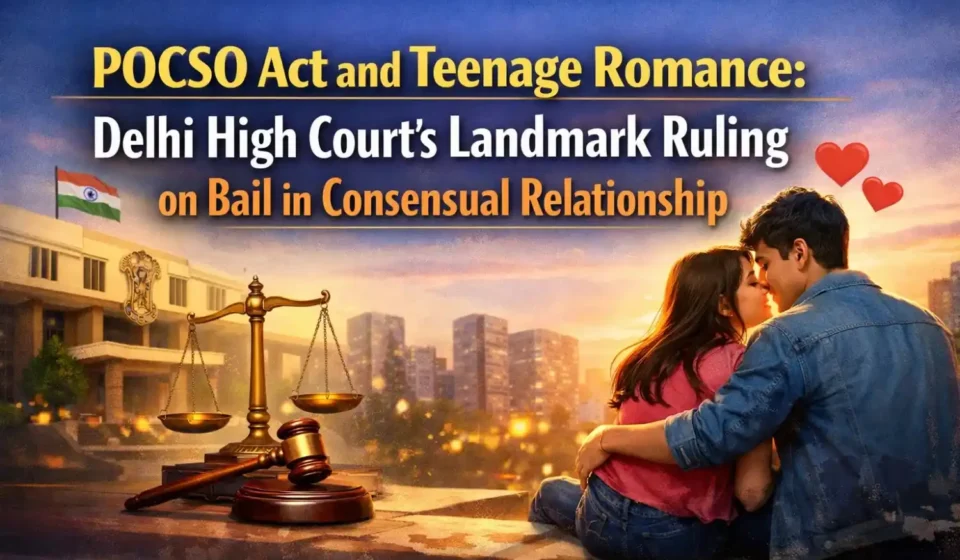
POCSO Act and Teenage Romance: Delhi High Court’s Landmark Ruling on Bail in Consensual Relationships

By Swati Bhardwaj
February 4, 2026 3 Min Read
0

The Protection of Children from Sexual Offences (POCSO) Act, 2012 is one of the most strict laws in the Indian legal framework that aimed to protect minors from any kind of sexual abuse. But in recent years, there have been many such challenges before the courts where a “consensual romantic relationship” exists between the accused and the victim.

Recently, the Hon’ble Justice Vikas Mahajan of the Delhi High Court while granting bail in a case has given a major verdict in the direction of striking a balance between the reality of these relationships among juveniles and the strict provisions of the law.

Background to the case and the court’s observations:

Background of the case and Court’s observations: In this case, the accused was booked under various sections of the POCSO Act. During the trial, it emerged that the relationship between the accused and the victim was of their own volition and there was no coercion or violence. Through a bone ossification test, the age of the victim was found to be about 17 years, which is very close to the threshold of adulthood.

Justice Vikas Mahajan made two very important observations while granting bail:

The legal status of the consent: The court made it clear that the consent of a child below 18 years of age has no value under the law. If there is a physical relationship, it will be considered a crime.

The basis of the guarantee: However, the court also stated that if the relationship is prima facie “romantic” and “non-coercive,” and the victim is close to 18 years of age, then these circumstances can be considered as a strong ground to grant bail to the accused.

Why is this judgment significant?

1. Bridging the gap between law and reality:

This ruling acknowledges an important social reality — that many teenagers between 16 and 18 years old enter into consensual romantic relationships driven by genuine emotions. In many such cases, when the girl’s family comes to know about the relationship, they file a POCSO case against the boy. The judgment tries to strike a balance between protecting children and avoiding the mechanical application of a strict law in cases involving teenage romance.

This court decision acknowledges that not every such case falls under the category of “sexual abuse” or “rape,” but can also be a result of natural attraction that develops with age.

2. Bail vs. Punishment: 

It is quite challenging to obtain bail under the POCSO Act. However, the High Court has clearly indicated that it is not justified to keep the accused in detention throughout the trial if he is not a habitual offender and the interaction with the victim was not forced.

3. Evolving Jurisprudence: 

This judgment is part of the evolving judicial thinking in India. Previously, several High Courts and the Supreme Court itself have stated that Parliament should consider amending the law regarding consensual relationships between adolescents so that the future of innocent young people is not ruined.

Lessons for Law Students and Legal Professionals

Insights for Legal Students and Practitioners

This case study serves as an excellent illustration of “Judicial Discretion” for law students gearing up for the AIBE, Judiciary, or other competitive assessments. It underscores the important difference between the literal interpretations of the law and their application within actual social situations.

Under Article 21 (Right to Life and Liberty), the accused has the right to a fair trial and protection from unnecessary incarceration, especially in instances where voluntary actions seem to have taken place.

Conclusion

This Delhi High Court ruling guarantees that “intent” and “circumstances” be taken into account in the scales of justice, without lessening the strictness of the POCSO Act. Even in situations when there is no real criminal intent, this is a huge comfort for young people who become involved in these situations because of a lack of legal knowledge.
View Judgement

For the most recent court developments and more legal information, keep checking wisdomvani.com.

Tags:

Consensual Teenage Romance POCSODelhi High Court JudgmentsJustice Vikas Mahajan RulingLandmark Bail DecisionsPOCSO Act 2012
Author

Swati Bhardwaj

Follow Me
Other Articles
Lawyers’ Right to Strike in India: Rajasthan HC 2026 Ruling and Article 21 Rights of Litigants WisdomVani.
Previous

Is Strike a Right or a Violation? Rajasthan HC’s Landmark Ruling on Bar Associations (2026)

Admissibility of Electronic Evidence in India: MP High Court 2026 Ruling on Pen Drive and Section 63 BSA WisdomVani.
Next

Why MP High Court Rejected Pen Drive Evidence in Malini Jain Case

No Comment! Be the first one.

Leave a Reply Cancel reply

Your email address will not be published. Required fields are marked *

Recent Posts

  • BA LLB 2nd Sem Economics-II Previous Year Question Paper May 2024 WisdomVani.
    BA LLB 2nd Semester Economics-II Question Paper MDU 2024
    by Swati Bhardwaj
    April 17, 2026
  • Legal format for an application seeking exemption from personal appearance in an Indian criminal court.
    Exemption Application Draft
    by Swati Bhardwaj
    January 1, 2026
  • WHAT IS A WAQF BOARD? WHAT IS THE NEW AMENDMENT OF 2025? WHAT IS THE DIFFERENCE BETWEEN OLD LAW AND AMENDMENT?
    by Swati Bhardwaj
    January 2, 2026
  • Legal framework of Import-Export laws in India covering FTDR Act and Customs Act.
    Evolution of Import-Export Laws in India: From Licence Raj to Liberalisation
    by Swati Bhardwaj
    January 3, 2026

A dedicated legal education platform designed to provide law students with easy access to high-quality study materials, scholarly research, and simplified insights into Indian jurisprudence.

Latest Posts

  • Why MP High Court Rejected Pen Drive Evidence in Malini Jain Case
    In the digital age, audio and video recordings are often… Read more: Why MP High Court Rejected Pen Drive Evidence in Malini Jain Case
  • WHAT IS A WAQF BOARD? WHAT IS THE NEW AMENDMENT OF 2025? WHAT IS THE DIFFERENCE BETWEEN OLD LAW AND AMENDMENT?
    What is a Waqf Board? A Waqf Board is a… Read more: WHAT IS A WAQF BOARD? WHAT IS THE NEW AMENDMENT OF 2025? WHAT IS THE DIFFERENCE BETWEEN OLD LAW AND AMENDMENT?
  • The Trade Unions Act, 1926: Objectives, Scope, and Landmark Case Laws
    For a law student, the Trade Unions Act, 1926, is not… Read more: The Trade Unions Act, 1926: Objectives, Scope, and Landmark Case Laws

Pages

  • About Us
  • Disclaimer
  • Privacy Policy
  • Terms and Conditions
  • Contact Us
Copyright 2026 — Wisdomvani. All rights reserved