Is Strike a Right or a Violation? Rajasthan HC’s Landmark Ruling on Bar Associations (2026)

The relationship between the Bar and the Bench has always been the cornerstone of the Indian judicial system. However, this bond often faces friction when lawyers resort to strikes or boycotts to protest administrative decisions. In a significant and strongly-worded judgment delivered on January 26-27, 2026, the Rajasthan High Court has once again ignited a national debate: Do lawyers have a fundamental right to strike, or does it infringe upon a citizen’s Right to Justice?
Why did the Strike Happen?
The recent unrest in the Rajasthan legal community began in early January 2026. The spark was a Full Court administrative resolution that introduced “Night Courts” and declared two Saturdays of every month as working days.
While the High Court administration aimed to reduce the massive backlog of cases, various Bar Associations, including those in Jaipur and Jodhpur, termed the move “impractical” and detrimental to the mental health and work-life balance of advocates. This led to a state-wide boycott, bringing judicial proceedings to a grinding halt.
The Landmark Ruling: Justice Over Protest
While hearing the case of Rajesh Kushwah v. State of Rajasthan, Justice Anoop Kumar Dhand of the Jaipur Bench took serious note of the ongoing boycott. The court’s observations serve as a stern reminder of the professional ethics and constitutional obligations of an advocate.
1. Violation of Article 21
The High Court held that a lawyer’s strike is not just a professional disagreement but a direct violation of Article 21 of the Constitution of India. The court observed:
“The right to speedy justice is a fundamental right of every litigant. When lawyers boycott courts, they hold the justice delivery system to ransom, especially affecting those languishing in jails whose personal liberty is at stake.”
2. Lawyers are “Officers of the Court,” Not Industrial Workers
The ruling clarified the legal status of advocates. Unlike factory workers who can resort to collective bargaining under labor laws, lawyers are “Officers of the Court.” Their primary duty is to assist the court in the administration of justice. The court reiterated that the “Right to Strike” is not a fundamental right for legal professionals.
Judicial Precedents: Strengthening the Ban
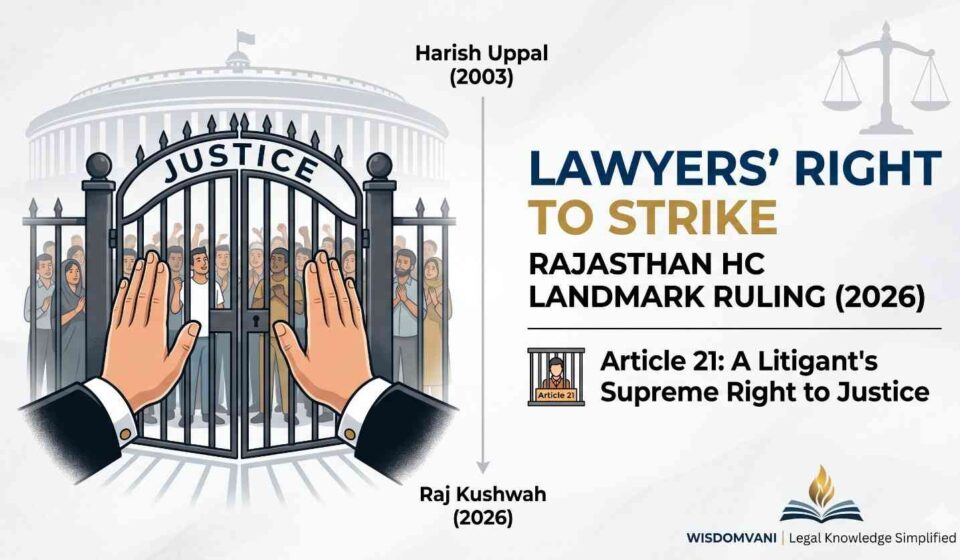
The Rajasthan High Court’s 2026 ruling is not an isolated opinion; it draws heavy inspiration from the Supreme Court’s landmark judgment in Ex-Capt. Harish Uppal vs Union Of India (2003).Ex-Capt. Harish Uppal Vs. UOI (2003)
Lawyers have no right to strike or give a call for boycott, even a token strike.
Common Cause Vs. UOI (2006)
Strikes by lawyers amount to professional misconduct.
District Bar Association, Dehradun Vs. Ishwar Shantanu (2020)
Bar Associations cannot pass resolutions to abstain from work.
Rajasthan HC (2026)
Boycott over working Saturday violates Article 21.
The Conflict: Professional Grievances vs. Litigants’ Rights
The Bar Associations argue that their protests are necessary to safeguard the interests of the fraternity. With the introduction of the New Criminal Laws (BNS, BNSS, BSA) in late 2024 and 2025, the workload on lawyers has increased significantly. Advocates argue that working on Saturdays and in “Night Courts” without adequate infrastructure is physically and mentally draining.
However, the Court’s counter-argument is simple: The Litigant comes first. For a person seeking bail or a victim waiting for a trial to conclude, a single day of boycott can mean another month in prison or a delay in receiving compensation.
Legal Consequences for Striking Lawyers
The Rajasthan High Court has signaled that “voluntary boycotts” will no longer be ignored. Potential consequences discussed in recent legal circles include:
- Contempt of Court: Office bearers of Bar Associations can face contempt proceedings for inciting strikes.
- Cost Imposition: Courts have the power to ask striking advocates to pay the costs of the day’s delay to their clients.
- Bar Council Action: Participation in illegal strikes can lead to the suspension of the license to practice under “Professional Misconduct.”
The Way Forward: Dialogue Over Disruption
The court suggested that while dissent is a part of democracy, it must be expressed through lawful channels. Instead of boycotting courts, Bar Associations should:
- Engage in negotiations with the High Court’s Administrative Committee.
- File representations to the Chief Justice.
- Hold peaceful protests outside court hours without affecting the cause list.
Conclusion
The Rajasthan High Court’s ruling on January 27, 2026, is a milestone in Indian jurisprudence. It firmly establishes that while a lawyer’s grievances may be genuine, the “Right to Justice” for a common citizen is supreme. As the legal profession evolves with new laws and digital courts, the balance between advocates’ welfare and judicial efficiency remains a tightrope walk.
For the legal fraternity, the message is clear: The gates of justice must never be locked.