Skip to content
Wisdomvani Wisdomvani

law

Wisdomvani Wisdomvani

law

  • Home
  • Law Study Material
    • Jurisprudence
    • Constitutional Law
    • Law of Contract
    • Company Law
    • Labour Law
    • Media Law
    • Hindu Law
    • Muslim Law
    • CPC
    • Criminal Law
    • International Business Law
  • PYQ
    • BA LLB
  • Question Bank
  • Judgements
    • Supreme Court
    • High Court
  • Legal Drafting
  • Home
  • Law Study Material
    • Jurisprudence
    • Constitutional Law
    • Law of Contract
    • Company Law
    • Labour Law
    • Media Law
    • Hindu Law
    • Muslim Law
    • CPC
    • Criminal Law
    • International Business Law
  • PYQ
    • BA LLB
  • Question Bank
  • Judgements
    • Supreme Court
    • High Court
  • Legal Drafting
Close

Search

Trending Now:
5 Essential Tools Every Blogger Should Use Music Trends That Will Dominate This Year ChatGPT prompts – AI content & image creation trend Ghibli trend – viral anime-style visual trend
Wisdomvani Wisdomvani

law

Wisdomvani Wisdomvani

law

  • Home
  • Law Study Material
    • Jurisprudence
    • Constitutional Law
    • Law of Contract
    • Company Law
    • Labour Law
    • Media Law
    • Hindu Law
    • Muslim Law
    • CPC
    • Criminal Law
    • International Business Law
  • PYQ
    • BA LLB
  • Question Bank
  • Judgements
    • Supreme Court
    • High Court
  • Legal Drafting
  • Home
  • Law Study Material
    • Jurisprudence
    • Constitutional Law
    • Law of Contract
    • Company Law
    • Labour Law
    • Media Law
    • Hindu Law
    • Muslim Law
    • CPC
    • Criminal Law
    • International Business Law
  • PYQ
    • BA LLB
  • Question Bank
  • Judgements
    • Supreme Court
    • High Court
  • Legal Drafting
Close

Search

Trending Now:
5 Essential Tools Every Blogger Should Use Music Trends That Will Dominate This Year ChatGPT prompts – AI content & image creation trend Ghibli trend – viral anime-style visual trend
Home/Blog/Rahul Gandhi Defamation Case: Karnataka HC Quashes 40% Commission Charges
Rahul Gandhi Defamation Case: Karnataka High Court quashes 40 percent commission charges complaint WisdomVani.
BlogHigh Court

Rahul Gandhi Defamation Case: Karnataka HC Quashes 40% Commission Charges

By Swati Bhardwaj
February 18, 2026 2 Min Read
0

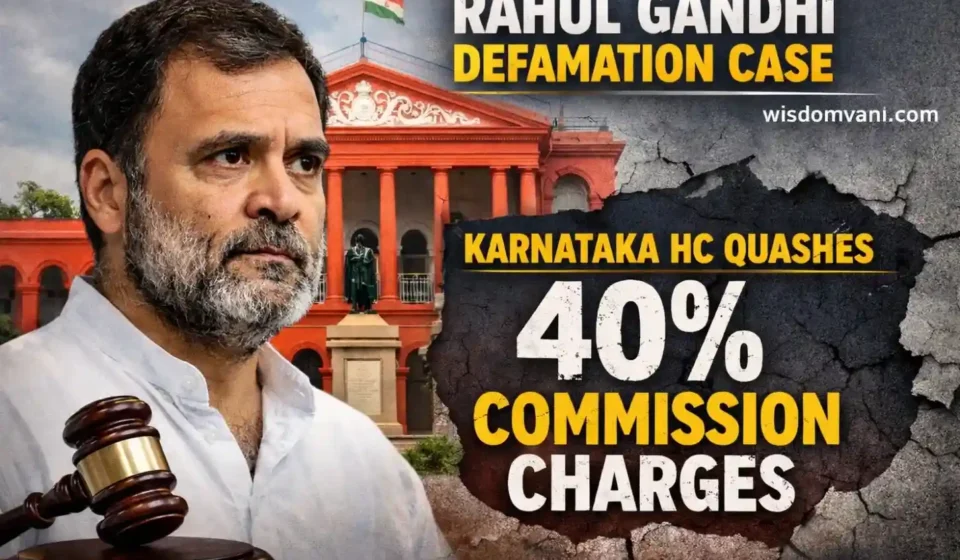
In a significant legal victory for the Leader of the Opposition, Rahul Gandhi, the Karnataka High Court on February 17, 2026, quashed the criminal defamation proceedings initiated against him by the Bharatiya Janata Party (BJP). The verdict, delivered by Justice S. Sunil Dutt Yadav, provides a robust precedent on the limits of criminal defamation in the context of political campaigning and administrative criticism.

Background: The “Corruption Rate Card” Controversy

The case has its roots in the high-decibel 2023 Karnataka Assembly election campaign. The Karnataka Pradesh Congress Committee (KPCC) had released full-page advertisements in mainstream newspapers featuring a “Corruption Rate Card.”

These advertisements alleged that the then-incumbent BJP government was a “40% Commission Government,” claiming that specific bribes were required for public works, transfers, and government appointments. The BJP’s state unit filed a private complaint, naming Rahul Gandhi as the fourth accused, alongside Chief Minister Siddaramaiah and Deputy CM D.K. Shivakumar.

Core Legal Issues Addressed by the Court

The High Court’s 2026 ruling is centered on three fundamental legal pillars:

1. The Principle of the “Aggrieved Person”

Under Section 199 of the Code of Criminal Procedure (CrPC), a defamation complaint can only be maintained by a person who is directly “aggrieved.” The Court observed that:

  • The advertisements targeted the “administration” and “constitutional functionaries,” not the political party as a separate entity.
  • Since the BJP state unit filed the case as a party, rather than the specific individuals allegedly defamed, the court found a lack of locus standi (the right to bring an action).

2. Absence of Direct Nexus

A critical point in the defense was that Rahul Gandhi did not hold an official organizational position (like President or Vice-President of the Congress) at the time the ads were issued.

  • The prosecution failed to provide documentary evidence linking Gandhi directly to the publication.
  • While it was alleged he “shared” the ads on social media (X), the court noted that the text of the alleged tweet and the mandatory Section 65B (Evidence Act) certificate were missing from the trial record.

3. Criticism of Administration is Not Defamation

Perhaps the most significant takeaway for democratic discourse was the Court’s observation on political speech. Justice Yadav remarked that criticizing the administration of a government cannot be brought under the purview of criminal defamation. The court held that such imputations often fall under the “Good Faith” exceptions of Section 499 of the IPC, as they involve matters of public interest.

Conclusion: A Shield Against “Legal Abuse”

The Karnataka High Court concluded that continuing the trial would be an “abuse of the process of law.” By setting aside the proceedings, the judiciary has reinforced the standard that criminal law should not be used as a tool to stifle political rivalry or administrative scrutiny.

While the case against other leaders may proceed based on their specific roles in the KPCC, Rahul Gandhi stands legally exonerated in this specific matter, marking a pivotal moment in his ongoing legal journey.

Tags:

BJP vs Congress Legal NewsCorruption Rate Card ControversyCriminal Defamation Section 499Justice Sunil Dutt Yadav RulingRahul Gandhi Karnataka High Court
Author

Swati Bhardwaj

Follow Me
Other Articles
Delhi High Court Suspension of Jail Sentence for Bollywood Actor: Interim Relief and Loan Dispute Details WisdomVani.
Previous

Rajpal Yadav Released: Delhi High Court Suspends Jail Sentence

Life and Contributions of Dr B.R. Ambedkar
Next

Dr. B.R. Ambedkar: The Life, Law, and Legacy of the Architect of Modern India

No Comment! Be the first one.

Leave a Reply Cancel reply

Your email address will not be published. Required fields are marked *

Recent Posts

  • Illustration of 'Delegatus Non Potest Delegare' showing a person unable to delegate authority, with a prohibition sign and balance scale.
    DELEGATUS NON POTEST DELEGARE
    by Swati Bhardwaj
    May 12, 2026
  • Legal format for an application seeking exemption from personal appearance in an Indian criminal court.
    Exemption Application Draft
    by Swati Bhardwaj
    January 1, 2026
  • WHAT IS A WAQF BOARD? WHAT IS THE NEW AMENDMENT OF 2025? WHAT IS THE DIFFERENCE BETWEEN OLD LAW AND AMENDMENT?
    by Swati Bhardwaj
    January 2, 2026
  • Legal framework of Import-Export laws in India covering FTDR Act and Customs Act.
    Evolution of Import-Export Laws in India: From Licence Raj to Liberalisation
    by Swati Bhardwaj
    January 3, 2026

A dedicated legal education platform designed to provide law students with easy access to high-quality study materials, scholarly research, and simplified insights into Indian jurisprudence.

Latest Posts

  • Why MP High Court Rejected Pen Drive Evidence in Malini Jain Case
    In the digital age, audio and video recordings are often… Read more: Why MP High Court Rejected Pen Drive Evidence in Malini Jain Case
  • WHAT IS A WAQF BOARD? WHAT IS THE NEW AMENDMENT OF 2025? WHAT IS THE DIFFERENCE BETWEEN OLD LAW AND AMENDMENT?
    What is a Waqf Board? A Waqf Board is a… Read more: WHAT IS A WAQF BOARD? WHAT IS THE NEW AMENDMENT OF 2025? WHAT IS THE DIFFERENCE BETWEEN OLD LAW AND AMENDMENT?
  • The Trade Unions Act, 1926: Objectives, Scope, and Landmark Case Laws
    For a law student, the Trade Unions Act, 1926, is not… Read more: The Trade Unions Act, 1926: Objectives, Scope, and Landmark Case Laws

Pages

  • About Us
  • Disclaimer
  • Privacy Policy
  • Terms and Conditions
  • Contact Us
Copyright 2026 — Wisdomvani. All rights reserved