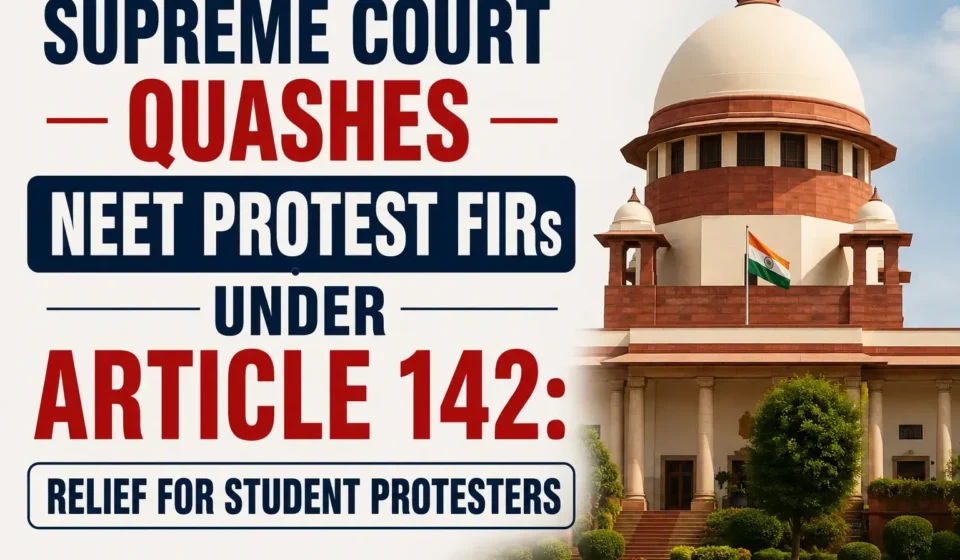

The Supreme Court of India made a decision on September 1 2026. The Court said that all FIRs connected to the NEET-UG protests that happened from July 20 to July 25 should be canceled. The group of judges used their powers under Article 142 of the Constitution to stop these cases over the country.
This choice has given a lot of relief to the thousands of people who took part in protests about problems, in the NEET-UG 2026 exam. Many students and their families were worried that criminal cases could hurt their studies and jobs. The Court explained that their main goal was to protect the future of those who spoke out in faith.
Background of the NEET-UG Protests
Protests started after news of a paper leak and other problems related to the National Eligibility cum Entrance Test (NEET) for courses. The Cockroach Janata Party (CJP) led student and youth groups who came together at Jantar Mantar in Delhi and in other states. They asked for responsibility, including the resignation of the person who was the Union Education Minister, at that time.
The agitation continued for weeks. Some incidents turned disruptive. Police registered FIRs in Delhi, Bihar, Maharashtra, West Bengal, Assam and elsewhere. Charges in many cases included rioting, damage to property and related offences. For ordinary student protesters, these cases created real anxiety. An FIR can affect job applications, further studies, and even travel plans long after the event ends.
By late July, the Centre had given certain assurances. Protesters called off the main phase of the agitation. Still, the FIRs remained on record until the Supreme Court stepped in.
What Exactly Did the Supreme Court Order?
A three-judge bench headed by Chief Justice of India Surya Kant, along with Justices Joymalya Bagchi and V. Mohana, heard applications from the Centre (through Delhi Police) and several states. The states themselves asked the court to close the cases.
The court ordered:
- Quashing of all FIRs specifically listed in the applications from Delhi, Bihar, Maharashtra, West Bengal and Assam that related to the protests between July 20 and July 25.
- Closure of any other FIRs registered in any state or Union Territory for the same period and incidents, even if those cases had not been formally placed before the court. These shall not be investigated and stand closed for all purposes.
- A bar on registration of any fresh FIR by any state or Union Territory for incidents linked to the protests during that window.
- Permission for Delhi Police to register one fresh FIR against 2,873 individuals identified as having serious criminal antecedents who were present at the Jantar Mantar protests. This step does not prejudice the rights of those individuals to seek legal remedies.
The bench stressed that the order was passed keeping in mind the future of young protesters who had joined the demonstrations bona fide. It also clarified that the directions arose from the peculiar facts of this case and should not be treated as a precedent.
Why Article 142 Mattered Here
Article 142 allows the Supreme Court to pass any order necessary to do complete justice in a matter before it. Courts use this power sparingly. In this instance, the bench found it appropriate because ordinary criminal procedure would have left many students facing prolonged uncertainty.
Solicitor General Tushar Mehta informed the court of the Centre’s position. The government no longer wished to pursue the broader set of cases against ordinary participants. The court accepted that approach and extended the relief nationwide so that students in different states would not face unequal treatment.
Think of a student from a small town in Bihar or Assam who travelled to a protest site, got named in an FIR, and then returned home to prepare for the next academic year. Without this order, that student might have spent months or years dealing with court dates and police notices. The Supreme Court removed that burden for the large majority.
The Exception for Individuals with Criminal Antecedents
The relief is not absolute. Delhi Police identified 2,873 people present at the main protest site who, according to records, had serious prior cases involving grave offences. The court allowed a focused investigation into their role in any violence or property damage. Ordinary participation in the protest itself was not treated as an offence.
This distinction matters. It separates students and first-time participants from those already facing serious charges. The order protects the former while allowing the justice system to examine the latter.
Compensation Directives
The court did not stop at closing the criminal cases. It directed the Centre to formulate modalities for a compensation scheme for protesters injured during police action. Once finalised, states and Union Territories should adopt it as a regular mechanism.
Separately, the Centre must provide compensation within three months to families of students who died by suicide in connection with the NEET-UG 2026 controversy. This recognition of the human cost of the examination crisis adds an important layer of accountability.
Immediate Reactions and Practical Impact
Following the order and the Centre’s assurances, CJP leaders announced that they were calling off their planned September 5 protest march. One of the group’s representatives informed the court of this decision during the hearing.
For students named in the quashed FIRs, the practical effect is clear. Those cases will not hang over their educational or professional records. Colleges, employers and other authorities will not see pending criminal proceedings linked to the July protests for the vast majority of participants.
Real-world examples are easy to picture. A medical aspirant who joined a peaceful sit-in and later received a notice can now focus on studies instead of legal anxiety. A family that feared an FIR would block a government job application can breathe easier. At the same time, anyone involved in actual violence remains subject to proper investigation where the facts support it.
Why This Order Matters Beyond One Set of Cases
Student protests often come from problems, about whether exams are fair whether there are enough chances and whether everything is equal. When a lot of people go out into the streets people watching are hoping the government and the courts will respond properly. Using Article 142 the Supreme Court managed to close cases but also left a way for those who did serious things to be dealt with. This decision tried to balance holding people with not ruining the future of the young people involved.
The order also signals that mere presence at a protest does not automatically invite lasting criminal liability. That principle is important in a democracy. At the same time, the court refused to create a blanket immunity that would cover those with serious prior records or those who crossed into violence.
Parents, teachers and students watching the NEET process will note the compensation directions. Examination controversies carry real human costs. Addressing those costs through a structured response is a step toward greater responsibility on the part of authorities.
The Supreme Court’s decision on the NEET protest FIRs offers concrete relief to many young Indians while preserving the state’s ability to deal with genuine criminality. It closes one chapter of a turbulent summer and leaves the focus where it belongs—on fair examinations, accountable systems, and the futures of the students themselves.