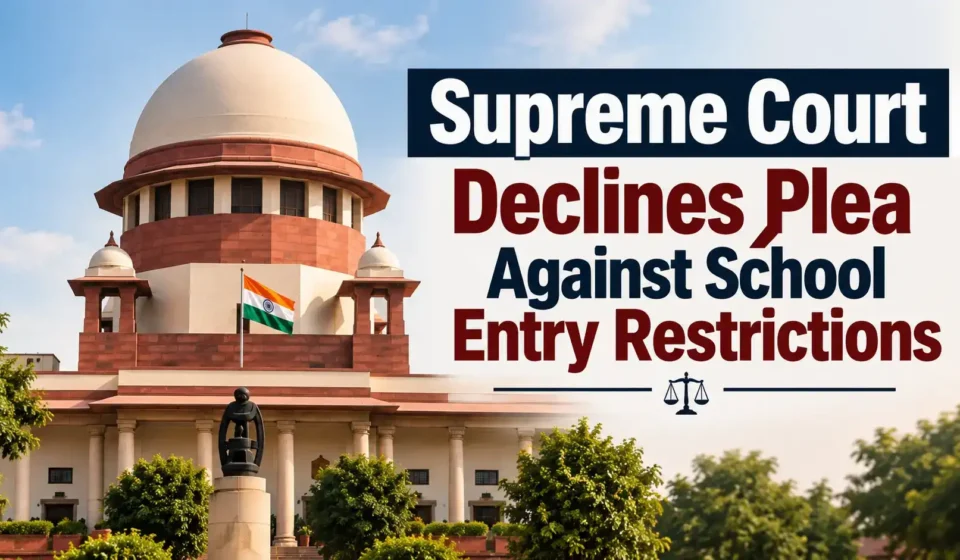

Recently, the Supreme Court of India declined to interfere with the restrictions imposed by the Uttar Pradesh and Rajasthan governments regarding the entry of outsiders into government schools. The Court refused to hear a Public Interest Litigation (PIL) that challenged the restrictions placed on media personnel, social media influencers, activists, and other outsiders, as well as the ban on unauthorized recording and live-streaming within school premises.
Following this order, the existing rules will remain in effect for the time being. Prior permission will continue to be mandatory for outsiders to enter or film inside schools in these two states.
What exactly was the Supreme Court’s ruling?
A bench comprising Justice P.S. Narasimha and Justice Alok Aradhe heard the petition filed by Priya Mishra under Article 32 of the Constitution. The Court simply stated that it was not inclined to hear the writ petition.
The petition had targeted:
An August 16, 2026 circular issued by Rajasthan’s Director of Secondary Education.
An August 19 order from the District Basic Education Officer in Ayodhya, Uttar Pradesh.
Similar directions issued in several other Uttar Pradesh districts, including Azamgarh, Ballia, Basti, Balrampur, Shamli and Agra.
Under these orders, outsiders must obtain prior permission from the school principal or a competent authority before entering government school premises. Additionally, written approval is required for photography, videography, interviews, audio recording, or live-streaming involving students, teachers, or school activities. Unauthorized entry or recording may lead to police action.
Why Were These Restrictions Introduced?
The rules came into force shortly after the Cockroach Janta Party (CJP) announced its “School Thik Karo” campaign. The campaign aims to inspect government schools and document problems such as broken buildings, missing toilets, lack of drinking water, teacher shortages and poor mid-day meal arrangements.
In Rajasthan, the circular appeared within hours of the campaign’s announcement. Authorities in Uttar Pradesh followed with similar directions. Officials appear to have acted out of concern over children’s privacy, safety and the risk of disruption to regular classes.
Many parents and teachers support controlled access. Schools are not public parks. Children deserve a safe environment free from constant filming or unexpected visitors. At the same time, government schools receive public money. Citizens and journalists often want to check whether basic facilities actually exist on the ground.
Arguments Raised in the Petition
The petitioner argued that while children’s privacy deserves protection, the restrictions went too far. She claimed they created an unreasonable barrier against documenting the real condition of public schools. The petition pointed to alleged violations of Articles 14, 19, 21 and 21-A of the Constitution.
Key points raised included:
- Blanket prior-permission rules make independent scrutiny difficult.
- Documenting classrooms, toilets, water facilities and infrastructure is different from filming identifiable children or collecting personal data.
- Public interest reporting can help improve government schools by bringing problems to light.
- The orders risk deterring journalists, YouTubers and activists from highlighting genuine issues.
The petition asked the court to quash the restrictive parts of the orders and declare that any regulation of public-interest documentation must meet tests of reasonableness, necessity and proportionality.
The Court’s Approach
The Supreme Court chose not to examine these arguments in detail. By declining to entertain the petition, the bench left the state-level circulars and orders untouched. This means the permission-based system remains valid in Rajasthan and the affected districts of Uttar Pradesh.
Courts often show caution when dealing with school premises. Judges recognise that education authorities need room to manage day-to-day functioning and protect minors. The decision reflects that institutional preference for limited interference in administrative measures concerning schools.
Practical Impact on the Ground
For journalists, content creators and activists, the rules create clear hurdles. Anyone planning a visit must first approach the principal or district education office and obtain written permission. Without it, entry or recording can lead to legal consequences under relevant laws, including provisions of the Bharatiya Nyaya Sanhita and the Protection of Children from Sexual Offences Act.
School principals now hold greater control over who enters their premises. This can reduce unannounced disruptions. It can also make it harder for outsiders to capture unfiltered images of poor infrastructure.
Consider a practical example. A local reporter wants to show that a government primary school still lacks functional toilets after years of complaints. Under the new rules, the reporter must first seek permission. If the principal delays or refuses, the story may never get visual evidence. On the other hand, a sudden visit by multiple camera teams during class hours can disturb teaching and make children uncomfortable.
Balancing Transparency and Child Protection
This case highlights a genuine tension. Government schools need public oversight. Poor infrastructure affects learning outcomes and children’s health. Social media and independent reporting have repeatedly exposed problems that official inspections sometimes miss.
At the same time, schools are sensitive spaces. Children should not become subjects of unregulated filming. Unauthorized livestreaming can raise serious privacy and safety concerns. Authorities argue that prior permission allows them to balance both interests — permitting legitimate visits while preventing misuse.
The Supreme Court’s refusal to intervene leaves this balance in the hands of state education departments for the time being. Future challenges may still arise in high courts or through different legal routes if the rules are applied in an arbitrary manner.
What Happens Next?
The “School Thik Karo” campaign and similar efforts can continue, but participants must follow the permission process in Rajasthan and the relevant Uttar Pradesh districts. Education departments may receive more formal requests for inspection visits. Principals will need clear guidelines on when to grant or refuse permission so that decisions do not appear selective.
Parents, teachers and local communities remain free to raise concerns through official channels, parent-teacher meetings or existing grievance mechanisms. The court’s order does not stop internal accountability. It only declines to strike down the entry and recording restrictions at this stage.
The decision underscores a simple reality. Access to government institutions, especially those involving children, often comes with conditions. Courts are generally reluctant to remove those conditions unless clear constitutional violations are shown. In this instance, the Supreme Court found no sufficient reason to step in.
For now, the message is clear. Anyone wishing to enter or record inside government schools in these states must first obtain the required permission. The restrictions stay in force.