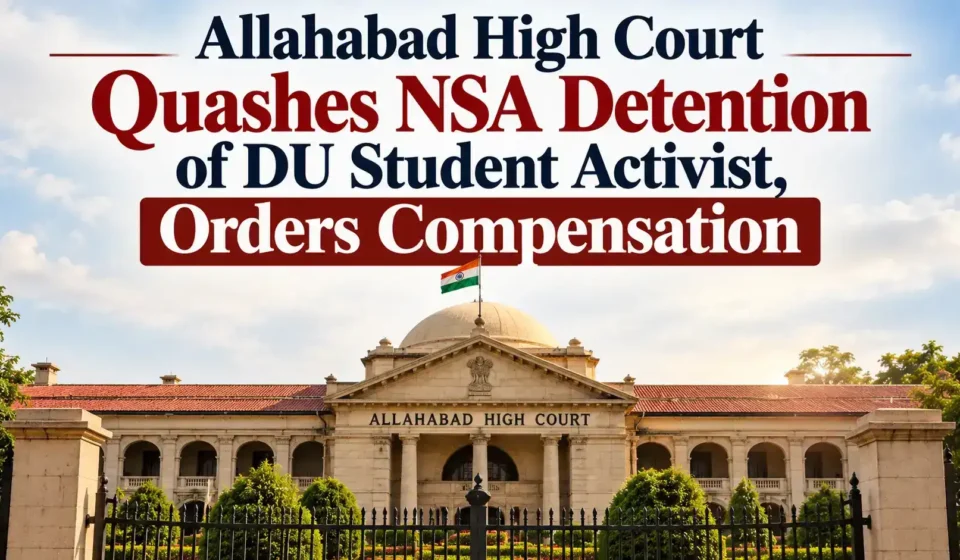
Allahabad High Court Quashes NSA Detention of DU Student Activist, Orders Compensation

The Allahabad High Court recently delivered a strong order quashing the National Security Act (NSA) detention of Delhi University graduate and student activist Akriti Chaudhary. The court found serious flaws in the detention process linked to the Noida workers’ protest and directed that she receive ₹5 lakh as compensation. Importantly, the amount will come from the salaries of the officials responsible, not from public funds.
This judgment sends a clear message about the limits of preventive detention powers.
What Happened in the Case?
Akriti Chaudhary, a 24-25 year old history graduate from Delhi University, was arrested in connection with a large workers’ agitation in Noida in April 2026. The protests involved demands for better wages. Police later booked her and others under various criminal cases. On May 13, authorities invoked the National Security Act against her.
She spent several months in custody under the NSA. Her lawyers filed a habeas corpus petition challenging the detention. A division bench of Justices Atul Sreedharan and Achal Sachdev heard the matter and ultimately quashed the detention order.
Key Findings of the High Court
The bench examined the timeline and the material placed before the detaining authority carefully. Several points stood out:
- Chaudhary had already been taken into police custody around April 11-12.
- The violence and arson she was accused of instigating took place on April 13.
- The court asked how a person already in custody could be held responsible for incidents that occurred later.
- The grounds of detention lacked solid evidence. The bench described the state’s version as a “concocted story.”
- The detention order showed non-application of mind and was based on assumptions rather than concrete material.
The judges held that her continued detention under the NSA violated her fundamental right to life and personal liberty under Article 21 of the Constitution.
Strong Criticism of the Administration
The court did not stop at quashing the order. It came down heavily on the Gautam Buddha Nagar administration and police. District Magistrate Medha Roopam, who passed the detention order, faced particular criticism. The bench observed that the authorities appeared to want to “set an example” and deter people from exercising free speech in support of workers.
In unusually sharp language, the court warned that continued “despotic” behaviour by errant officials could turn Uttar Pradesh into an “Orwellian dystopia.” It directed that its displeasure against the District Magistrate and the police officers involved in preparing the NSA dossier be recorded in their service records.
Compensation from Officials’ Salaries
The High Court awarded Akriti Chaudhary ₹5 lakh as compensation. Crucially, it ordered that the amount be recovered from the salaries of the responsible officers, starting from the District Magistrate and going right down to the Station House Officer who prepared the initial report. The money will not come from the state exchequer.
This direction is significant. It places personal financial accountability on the officers who exercise extraordinary powers under the NSA.
Why This Order Matters
The National Security Act is a preventive detention law. It allows authorities to detain a person without a regular trial if they believe the person may act in a manner prejudicial to public order or national security. Courts have repeatedly said that such powers must be used sparingly and strictly according to law.
In this case, the High Court found that the power was used without proper material and without genuine application of mind. The judgment reinforces two important principles:
- Preventive detention cannot become a tool to keep someone in custody when regular criminal law and bail provisions are available.
- Officials who misuse such powers can face personal consequences, including financial liability and adverse entries in service records.
For students, activists and ordinary citizens who participate in public protests, the order offers some reassurance. It shows that courts will examine the actual evidence rather than simply accept the administration’s narrative.
Practical Impact and Remaining Cases
While the NSA detention has been quashed, Chaudhary continues to face regular criminal cases arising from the same protests. Bail in those matters will be decided separately on their own merits. The High Court’s order deals only with the preventive detention under the NSA.
Still, the judgment is likely to influence how district administrations approach similar cases in future. Officers may think twice before invoking the NSA on weak or speculative grounds, knowing that courts can impose personal costs.
Balancing Security and Liberty
Every society needs tools to maintain public order. At the same time, those tools must not become instruments of convenience. When a detention order rests on assumptions rather than facts, and when a person already in custody is blamed for later events, the process loses credibility.
The Allahabad High Court’s decision restores some balance. It protects the individual’s liberty while reminding the executive that extraordinary powers come with extraordinary responsibility. Officials who exercise those powers must do so carefully, fairly and with clear evidence.
In the end, the court made it simple: personal liberty under Article 21 cannot be taken away on the basis of a concocted story. The NSA detention of Akriti Chaudhary stood quashed, and those who ordered it will bear the cost.