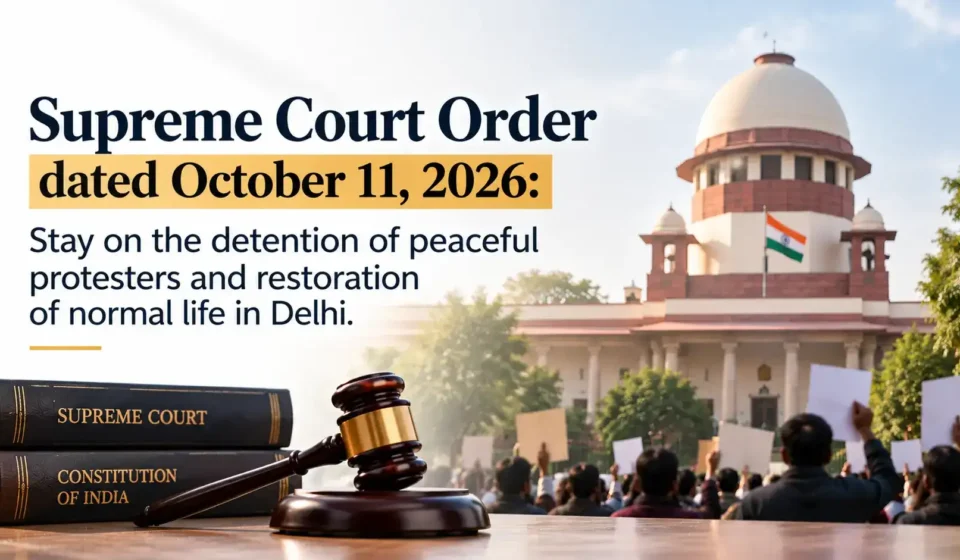
Supreme Court Order dated October 11, 2026: Stay on the detention of peaceful protesters and restoration of normal life in Delhi.

The Supreme Court on the protest against Chief Election Commissioner Gyanesh Kumar in Delhi held special hearing on Sunday, October 11, 2026. Justice Joymalya Bagchi and Justice V. Mohana’s bench gave clear instructions. Peaceful and unarmed protesters are not detained illegally. Metro and train services run normally. Don’t interrupt the internet. People’s voice was free.
This order came after the October 10 large police action. Thousands of people were detained that day. Metro station was closed. Internet was affected in some areas. The court had also earlier clarified on October 9 that there was no complete restriction on metros and trains.
Background: Why was a special hearing held?
CJP and some student organisations had called for the protest on Jantar Mantar over the demand of resignation of the Chief Election Commissioner. There were allegations that irregularities took place in the SIR process. Police made a tough security system. Hundreds of people were detained. Many metro stations were closed. There was also an impact on railway stations.
Petitioners told the court that the October 9 order was violated. Peaceful people were detained without process. Section 163 took action outside the banned area of BNSS. The court called special meeting on Sunday.
Key directives of the Supreme Court
The court issued interim directions. These directions are subject to the law and order situation.
- Stop on illegal custody: Peaceful and unarmed people be detained only in accordance with the process established by law. Especially in areas where the ban of Section 163 BNSS is not applied.
- Metro and rail services: Metro and rail facilities run normally. A ban can be imposed under Article 19(2) in case of interrupting public order only.
- Internet: Internet services remain unbeaten in accordance with the law. The court clarified that this instruction does not steal valid powers under IT Act.
- Travel: Free movement of people in the city is allowed. Traffic rules are necessary to follow.
- Barricading review: be immediately reviewed of the need to plant Barricade. Take into account the law and order and traffic situation.
- Supreme Court Complex: A ban of Section 163 be removed around the Supreme Court and other courts so that access to justice is not interrupted.
- Lawyers and Journalists: Lawyers and journalists are not to hinder their professional work.
The court also issued a notice on contest petition. Answer from the officials was asked why the subway closed on October 10 violated the October 9 order.
What is the legal significance?
This order emphasizes the balance between fundamental rights and administrative power. Article 19(1) (a) and 19(1) (b) give freedom of peaceful assembly and expression. But Article 19(2) and 19(3) allow reasonable restrictions.
The court said the right to performance. But the process should be under the scope of the Police Act and the law. Peaceful department cannot be made a hunt of illegal custody.
Practical example. If a person stands peacefully outside the banned area then it is wrong to take him in custody without reason. The court repeated that theory.
What does it mean for the common citizen?
This order is important for both Delhiites and protesters.
- The common man can go home from the metro. Unnecessary won’t be closed.
- The right to peaceful protest is safe, but action may be taken on violence or breaking law.
- Proper reasonable reason and process is necessary before closing the internet.
- Access to the court was ensured.
The court repeatedly said that care for the future of young protesters should be taken. be protected from unnecessary legal confusion.
What next?
The court asked the officials to submit compliance reports. Continuing petition and prisoners will continue hearing of the directing petitions. The Centre and Delhi Police have to hold their side.
This case shows that the Supreme Court is playing an active role in protecting fundamental rights. He also gives importance to public order. The balance between the two is the identity of democracy.
The right to peaceful opposition is the soul of the Constitution. The court again reminded that this right should be used within the law. And the administration should also take action by staying in the law limits.