
Introduction
In a significant ruling that reinforces the protective intent behind maintenance law in India, the Gujarat High Court has made it clear that a woman holding an LLB degree cannot be denied maintenance simply because she has a law qualification. The judgment, delivered by Justice Hasmukh D. Suthar, came in a revision petition filed by a divorced woman who was challenging both the denial of adequate maintenance and the reasoning used against her claim.
This decision is worth paying attention to — not just by lawyers or litigants, but by anyone who wants to understand how courts look at the financial rights of divorced women in India today.
Background of the Case
The case involved a couple who got married in December 2008. In the early months, the marriage appeared normal, but the wife alleged that within about six months, things turned dark. According to her, she was subjected to physical and mental harassment by her husband and his family members over dowry demands. The husband, who was reportedly engaged in singing and organising musical events both within India and abroad, was said to be earning a substantial income. The wife further alleged that he had developed an addiction to alcohol, which made the situation at home worse over time.
Eventually, the marriage ended and a divorce deed was signed. After the separation, the wife filed an application under Section 125 of the Code of Criminal Procedure (CrPC) before the Family Court in Ahmedabad, seeking monthly maintenance from her former husband. The Family Court initially awarded interim maintenance of Rs. 2,000 per month, but the husband reportedly failed to comply even with that modest amount.
After a full hearing, the Family Court directed the husband to pay Rs. 10,000 per month as maintenance to his divorced wife. However, the wife felt this amount was grossly inadequate given her husband’s income and her own circumstances, and she filed a revision petition before the Gujarat High Court seeking an increase to Rs. 25,000 per month.
What the Husband Argued
One of the arguments raised on behalf of the husband was that the wife held an LLB degree — meaning she was qualified in law — and therefore she was capable of earning her own livelihood. The implication of this argument was simple: if a woman is educated enough, especially in a field like law, she should not be entitled to maintenance because she can support herself.
This is not an unusual argument. Courts across the country have often encountered similar defences where the husband points to the wife’s educational qualifications, professional degrees, or even past employment to argue that she does not need financial support from him.
What the Gujarat High Court Said
The Court did not accept this line of reasoning.
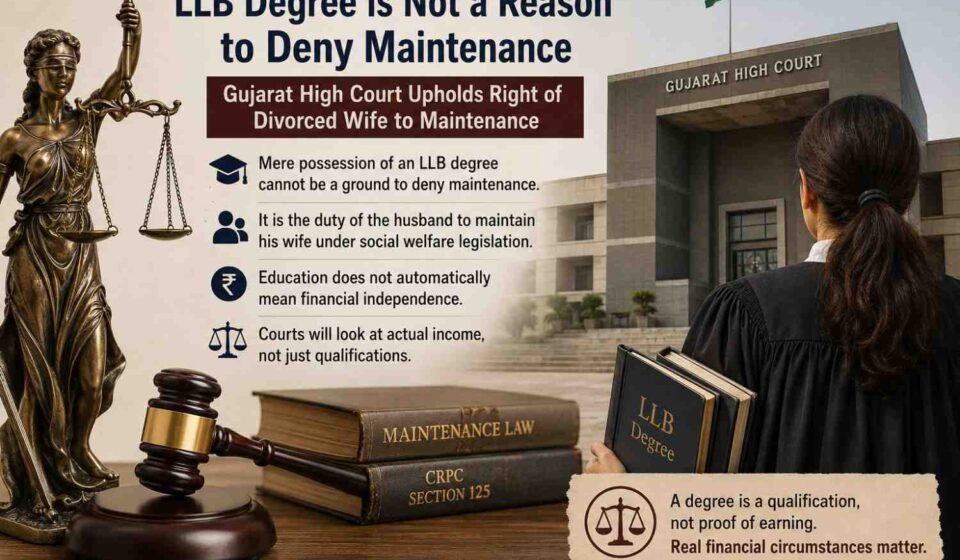
Justice Hasmukh D. Suthar, while examining the record, made a clear observation: merely because a divorced wife holds an LLB degree, that alone cannot be a ground to refuse her maintenance. The Court noted that this aspect had rightly been considered by the Family Court as well.
Quoting the Court’s reasoning: it is a settled principle of law that a divorced wife is entitled to maintenance. More importantly, the Court emphasised that under social welfare legislation, it is the duty of the husband to maintain his wife — and that duty does not disappear just because the wife has an educational qualification on paper.
This is a crucial distinction. Possessing a degree is not the same as actually being employed and earning an income. An LLB degree does not automatically mean a woman is practising as a lawyer, earning a steady salary, or is in a position to be financially self-sufficient. The Court, in essence, refused to conflate education with financial independence.
The Court’s Final Decision
While upholding the core principle that maintenance cannot be denied on the basis of an LLB degree, the High Court also examined whether the amount of Rs. 10,000 per month awarded by the Family Court needed to be increased.
The wife had argued that her husband earned a substantial income from his singing career and event management work, both in India and abroad. However, the Court, after reviewing the material on record, did not find sufficient evidence to justify enhancing the maintenance amount beyond what the Family Court had already awarded.
The revision petition seeking an increase to Rs. 25,000 per month was therefore dismissed. The Court upheld the Family Court’s order of Rs. 10,000 per month as the maintenance amount — but importantly, it did so while firmly rejecting the argument that the wife’s LLB degree was a reason to deny or reduce her maintenance.
Why This Ruling Matters
1. Education Alone Does Not Equal Financial Independence
One of the most important takeaways from this judgment is the Court’s refusal to treat a professional degree as proof of earning capacity. A law degree, or any degree for that matter, is merely a qualification. Whether a person is actually working, whether they have access to employment opportunities, whether they have been out of the workforce for years due to domestic responsibilities — all of these factors matter when deciding maintenance.
In India, a large number of women pursue education but leave their careers after marriage. They may have degrees but no active income. Using a degree as a weapon to deny maintenance would effectively punish women for being educated while simultaneously failing to account for the actual financial reality of their lives.
2. The Purpose of Section 125 CrPC
Section 125 of the CrPC — now mirrored under Section 144 of the Bharatiya Nagarik Suraksha Sanhita, 2023 — was specifically enacted as a measure of social welfare. Its purpose is to prevent vagrancy and destitution, and to ensure that women and children are not left without any financial support after the breakdown of a marriage.
The Supreme Court of India has, on multiple occasions, held that this provision must be interpreted broadly and liberally in favour of the person claiming maintenance. The Gujarat High Court’s observation in this case is consistent with that approach. The bench correctly noted that social welfare legislation casts a clear duty on the husband to maintain his wife, and that duty cannot be brushed aside based on the wife’s academic credentials alone.
3. The Standard for Denying Maintenance Is Higher Than Having a Degree
For a husband to successfully argue that maintenance should be refused or reduced because the wife can support herself, courts generally look for actual proof of income, not just theoretical earning capacity. If a wife is actually earning a salary, running a business, or has independent financial means, that is a relevant factor. But simply having studied law, or medicine, or any other subject, does not amount to having the means to support oneself.
This ruling sets an important standard: the bar for denying maintenance cannot be as low as “she has a degree.”
Broader Context: How Courts Have Looked at This Issue
The Gujarat High Court’s ruling fits into a broader pattern of judicial thinking on maintenance law in India.
Courts have consistently held that a wife’s right to maintenance is not forfeited merely because she is educated. Various High Courts have noted that the husband cannot escape his responsibility by pointing to his wife’s qualifications if she is not actually employed or earning. The focus is always on the actual financial situation of the parties, not on theoretical possibilities.
Similarly, courts have rejected arguments that women should be denied maintenance because they are capable of working, but choose not to. The choice to not work, particularly in the context of a marriage where domestic responsibilities may have taken precedence, is something courts take into account when determining the right to maintenance.
At the same time, courts do consider actual employment and income. If a wife is proven to be drawing a regular salary or is found to have sufficient independent income, that will certainly influence the quantum of maintenance awarded.
Practical Implications for Litigants
For women going through divorce proceedings or maintenance disputes, this judgment offers a degree of reassurance. Simply holding an educational degree — whether in law, medicine, engineering, or any other field — will not automatically disqualify a person from claiming maintenance. Courts will look at the complete picture.
For husbands seeking to defend against maintenance claims, this judgment is a reminder that the argument of “she is educated and can earn” needs to be backed by actual proof of earning, not just proof of a degree. A certificate alone will not do.
For lawyers handling matrimonial matters, this ruling is a useful reference point when opposing or countering arguments that seek to use a wife’s education as a ground to deny or reduce maintenance.
Conclusion
The Gujarat High Court’s observation in Dhruti Vinubhai Dodiya v. State of Gujarat & Anr. is a clear and practical affirmation of something that should be intuitive: education and financial self-sufficiency are not the same thing. A woman with an LLB degree may be living in circumstances where she cannot find work, where years of domestic life have kept her away from professional practice, or where she simply has no steady income despite her qualification.
Maintenance law in India was designed to protect people from being left without support. Allowing educational degrees to become a shortcut for denying that protection would defeat the entire purpose of the law.
By upholding the Family Court’s maintenance order while firmly rejecting the LLB-based argument, the Gujarat High Court has reinforced an important principle: the right to maintenance must be evaluated on real financial circumstances, not on paper qualifications.