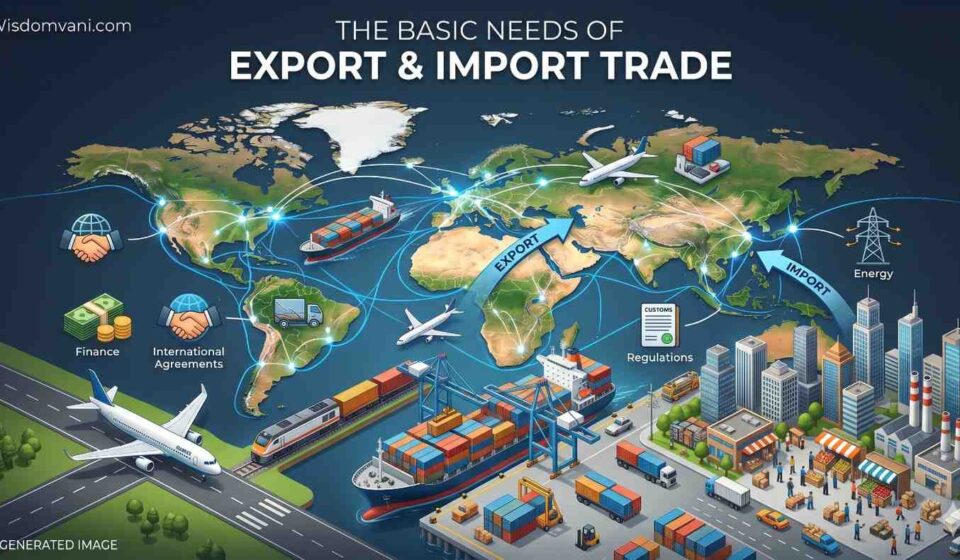

1. Introduction: Trade Goes Far Beyond the Product Itself
Imagine purchasing a smartphone. It might have been assembled in a factory in China, but its software comes from Silicon Valley in the United States, its advanced chips from South Korea, and its vibrant display from Taiwan. A Singapore-based shipping line transports it, a British insurer covers the risks during the journey, and Indian customs officials clear it after a freight forwarder handles the paperwork. This everyday purchase reveals the intricate web of international trade. The phone itself is merely the visible tip of a much larger system.
When we talk about “the basic needs of export and import trade,” we are really discussing this entire ecosystem. International trade isn’t just about swapping physical items across borders. It involves moving tangible goods, delivering intangible services at every step, and relying on robust transportation networks that link buyers and sellers across vast distances. These three core pillars—goods, services, and transportation—each come with their own layers of domestic and international rules. For lawyers handling trade deals, customs issues, shipping agreements, or policy matters, grasping all three is crucial. Partial understanding simply won’t suffice.
India offers a compelling case study. As the world’s fifth-largest economy, the country has transformed its foreign trade from something almost insignificant after independence to well over a trillion dollars today. Its legal system for trade has matured significantly—from the protectionist policies of the early decades to the more open, WTO-aligned approach of recent years. This evolution continues as new realities emerge, such as booming digital services and complex multimodal logistics. Understanding this framework helps anyone navigating India’s place in global commerce.
The Three Pillars of Trade
- Goods: Physical, tangible items that have defined trade for centuries.
- Services: Intangible offerings like software, consulting, finance, and education.
- Transportation: The essential bridge—shipping, air cargo, and logistics—that makes everything possible.
2. Trade in Goods: The Bedrock of Global Commerce
Throughout most of history, international trade revolved around physical goods—items that could be packed onto ships, hauled by carts, or carried overland. Even now, with services growing rapidly, goods still account for the bulk of global trade value. For anyone studying international commercial law, starting with goods trade provides the essential foundation.
2.1 Defining “Goods” Under Indian Law
Indian law takes a broad view of what qualifies as “goods.” Section 2(e) of the Foreign Trade (Development and Regulation) Act 1992 (FTDR Act) includes all movable property, such as currency, bullion, materials, and commodities. The Customs Act, 1962 echoes this, covering stores, baggage, and any movable items. Meanwhile, the Sale of Goods Act, 1930 defines goods as every kind of movable property except actionable claims and money.
In practice, trade law categorizes goods in ways that shape how they are regulated: industrial items (machinery, electronics, chemicals), agricultural produce (spices, cereals, cotton), primary commodities (oil, metals, minerals), and everyday consumer products (apparel, footwear, packaged foods). Each category faces unique rules—different duties, licenses, safety checks, and treaty obligations. This classification isn’t just bureaucratic; it directly affects business costs and strategies.
2.2 Core Laws Governing Goods Trade in India
Several key statutes form the backbone of goods trade regulation:
- Foreign Trade (Development and Regulation) Act, 1992: This is the central law, empowering the Directorate General of Foreign Trade (DGFT) to manage imports and exports via the Foreign Trade Policy.
- Customs Act, 1962: It handles duty collection, clearance procedures, customs officers’ powers, and appeal mechanisms.
- Customs Tariff Act, 1975: Provides detailed duty schedules and supports measures like anti-dumping and safeguard duties.
- Essential Commodities Act, 1955: Allows the government to regulate production and distribution of essentials, sometimes restricting exports to protect domestic supply.
- Export (Quality Control and Inspection) Act, 1963: Ensures exported items meet quality standards through pre-shipment inspections for certain products.
These laws work together to create a structured yet adaptable system.
2.3 How India Classifies Goods for Trade Policy
The Foreign Trade Policy sorts goods into categories that determine how freely they can move:
- Free Category: Most items today. No special license needed—just a valid Importer Exporter Code (IEC). Think electronics, machinery, and general merchandise.
- Restricted Category: Requires specific approval from DGFT or other bodies due to health, security, or environmental concerns (e.g., certain chemicals, arms, or wildlife products).
- Canalized Category: Handled only through government agencies or state trading enterprises for strategic reasons (e.g., petroleum or specific fertilizers).
This system balances openness with necessary controls, reflecting India’s evolving priorities.
2.4 Customs Duties: The Cost of Border Crossing
Customs duties remain the government’s main tool for managing goods trade. Imports typically attract Basic Customs Duty (BCD), Integrated GST (IGST), and other charges. Export duties are rarer but apply to some raw materials to avoid domestic shortages. Everything hinges on the Harmonized System (HS) Code—an international standard India follows. Correct classification is critical, and disputes over HS codes fuel much of India’s customs litigation. Small errors here can mean big financial differences.
2.5 India’s Goods Trade at a Glance
In 2023–24, India’s merchandise trade (exports plus imports) reached around $778 billion. The country ranks 17th among global merchandise exporters and maintains regular trade ties with over 239 countries. These figures highlight India’s growing integration into world markets, though challenges like trade deficits persist.
3. Trade in Services: The Rising Star of India’s Economy
Many people still picture trade as container ships full of physical goods. Yet India’s services exports often outpace merchandise in key areas, making the country a global leader in services. IT, software, finance, and business process outsourcing (BPO) have redefined what “export” means here.
Services differ fundamentally from goods—they’re intangible. You can’t ship software on a vessel or inspect digital advice at a port. This creates opportunities (global delivery without heavy infrastructure) but also regulatory headaches, as old goods-focused rules don’t always fit.
3.1 The Four Modes of Services Trade (GATS)
The WTO’s General Agreement on Trade in Services (GATS) outlines four supply modes, each with distinct legal implications:
- Mode 1 (Cross-Border Supply): Service travels, not people. Indian IT firms delivering code online to U.S. clients. This powers India’s IT boom.
- Mode 2 (Consumption Abroad): Client travels to India—for medical tourism, education, or vacations.
- Mode 3 (Commercial Presence): Company sets up abroad (subsidiaries or branches), blending trade and investment law.
- Mode 4 (Movement of Natural Persons): Professionals travel temporarily (e.g., engineers on visas), intersecting with immigration rules.
3.2 India’s Strength in Services Exports
India has become the world’s preferred back office. Cities like Bengaluru, Hyderabad, Pune, and Chennai drive this success. Behind it lies solid legal support:
- Foreign Trade Policy 2023–28 extends benefits like SEIS to service exporters.
- FEMA 1999 ensures smooth current account transactions for service payments.
- Information Technology Act, 2000 supports e-commerce and digital contracts—vital for Mode 1.
- SEZ Act, 2005 offers incentives in IT-ITES zones.
- RBI schemes manage related capital flows.
3.3 Regulatory Challenges for Services
Services are “invisible” at borders, raising issues around quality, money laundering, and fair competition. India addresses these through licensing, data laws, and GATS commitments in sectors like IT and tourism. Balancing openness with protection remains an ongoing task.
4. Transportation: Connecting Goods and Services Across Borders
No trade happens without movement. Transportation law is highly specialized due to the high stakes, multiple parties, and cross-border complexities.
4.1 Main Modes of Transport
- Sea Transport: Carries ~90% of global trade volume. India’s ports and laws like the Carriage of Goods by Sea Act, 1925 are central.
- Air Transport: For urgent, high-value items. Governed by international conventions; major hubs in Delhi and Mumbai.
- Road and Rail: Key for regional trade with neighbors.
- Pipelines: Growing for energy, regulated by dedicated bodies.
4.2 The Bill of Lading: Trade’s Cornerstone Document
The Bill of Lading (B/L) acts as receipt, contract evidence, and title document. It enables secure trade finance and ownership transfer while goods are in transit.
4.3 Multimodal Transport
Modern shipments often combine modes. India’s 1993 Multimodal Transportation of Goods Act simplifies this with a single operator and document, reducing disputes.
4.4 INCOTERMS: Standardizing Responsibilities
INCOTERMS 2020 terms like FOB, CIF, EXW, and DDP clarify who handles costs, risks, and clearance—essential for clear contracts.
4.5 The Role of Insurance
Marine insurance, governed by the 1963 Act, protects against risks and is usually mandatory for financed deals.
5. How the Pillars Interconnect
Consider an Indian pharmaceutical export to Africa: goods face customs and quality rules; services include finance, insurance, and logistics; transportation involves bills of lading and INCOTERMS. A glitch in any area can derail everything. Lawyers must see the full picture.
6. Landmark Cases That Shaped Trade Law
Indian courts have clarified key principles through notable judgments:
A. Customs Valuation & Transaction Value
Eicher Tractors Ltd. v. Commissioner of Customs (2000)
This is one of the most important Supreme Court judgments on customs valuation in India. The Court made it very clear that the transaction value mentioned in the invoice should normally be accepted as the correct value for calculating customs duty. Customs officers cannot reject or increase this value just because they feel like it. They must have solid, concrete evidence of fraud, misdeclaration, or any other specific ground mentioned in the Customs Valuation Rules.
In simple words: The price actually paid or payable between the buyer and seller is the starting point — not suspicion or guesswork.
Century Metal Recycling Pvt. Ltd. v. Union of India (2019)
The Supreme Court once again strengthened the importance of transaction value. The Court said that increasing the assessable value is an exception, not a routine practice. Customs authorities cannot raise the value based on mere doubts, general internet prices, or vague comparisons. They must share proper comparable data with the importer and give them a chance to explain their side.
B. Tariff Classification (Commercial Parlance Test)
Collector of Central Excise v. Wood Craft Products Ltd. (1995)
This landmark case established the “Common Parlance Test” — a very practical rule for classifying goods under tariffs. The Supreme Court held that goods should be classified according to how they are commonly known, bought, and sold in the market by traders and consumers — not purely on technical or scientific definitions.
For example, if traders call something “plywood” in daily business, it should be treated as plywood even if its technical composition is slightly different. This judgment brought commercial reality into classification disputes.
Commissioner of Customs v. Dilip Kumar & Co. (2018)
This is a Constitution Bench decision and carries huge weight. The Court ruled that when there is any ambiguity in an exemption notification (or benefit notification), it must be interpreted strictly in favour of the government/revenue. The importer has to clearly prove that they are eligible for the exemption or benefit.
C. Carriage of Goods & Carrier Liability (Maritime Trade)
East and West Steamship Co. v. S.K. Ramalingam Chettiar (AIR 1960 SC 1058)
This older but very important case explained the true legal nature of a Bill of Lading. The Supreme Court held that the Bill of Lading is not just a receipt — it is a document of title and strong evidence of the contract of carriage. The Court also clarified the strict time limits under the Carriage of Goods by Sea Act within which a cargo owner can file a case against the carrier for loss or damage.
In short: The Bill of Lading is the most powerful document in sea trade, and both parties must respect the legal timelines.
British India Steam Navigation Co. Ltd. v. Shanmughavilas Cashew Industries (1990)
This judgment dealt with the liability of shipping companies and the consequences of deviating from the agreed route. The Supreme Court observed that if a ship unjustifiably changes its route without valid reason, the carrier loses many of the legal protections and limitations of liability given under maritime law.
D. Point of Importation & Duty Liability
Garden Silk Mills v. Union of India (1999)
This is a classic case on when customs duty actually becomes payable. The Supreme Court explained that the process of “importation” is not complete the moment the ship enters Indian territorial waters. Importation is a continuous process that ends only when the goods cross the customs barrier and are presented for clearance on land.
Therefore, the duty rate applicable on the date of actual customs clearance will apply — even if the goods were ordered or shipped earlier when the duty rate was lower. This judgment is extremely important for importers to understand timing and risk of duty changes.
These cases provide practical guidance for real-world disputes.
7. Shared Legal Requirements Across Pillars
Certain elements are universal:
- IEC: Mandatory entry ticket for trade.
- Trade Finance: Letters of Credit (UCP 600) build trust.
- Documentation: Invoices, packing lists, certificates of origin—accuracy is everything.
- Dispute Resolution: Arbitration under the 1996 Act is preferred.
- Insurance: Covers various risks.
- Customs Compliance: Bills of Entry/Shipping Bills via ICEGATE.
8. Conclusion: Mastering Trade Law Means Thinking in Systems
Goods, services, and transportation form one interconnected system. India’s framework—FTDR Act, Customs laws, FEMA, GATS, and more—has become sophisticated. Courts emphasize balanced regulation that supports, rather than stifles, trade.
For law students and practitioners, the lesson is clear: view the entire chain. From production to delivery, every link matters. The most effective trade lawyers integrate knowledge across all pillars, helping clients thrive in global markets while staying compliant and protected. This holistic approach isn’t just good practice—it’s essential in today’s interdependent world.