
If you are a law student or a fresh graduate planning to appear in the Civil Judge (Junior Division) examination, the last 15 months have been a rollercoaster.
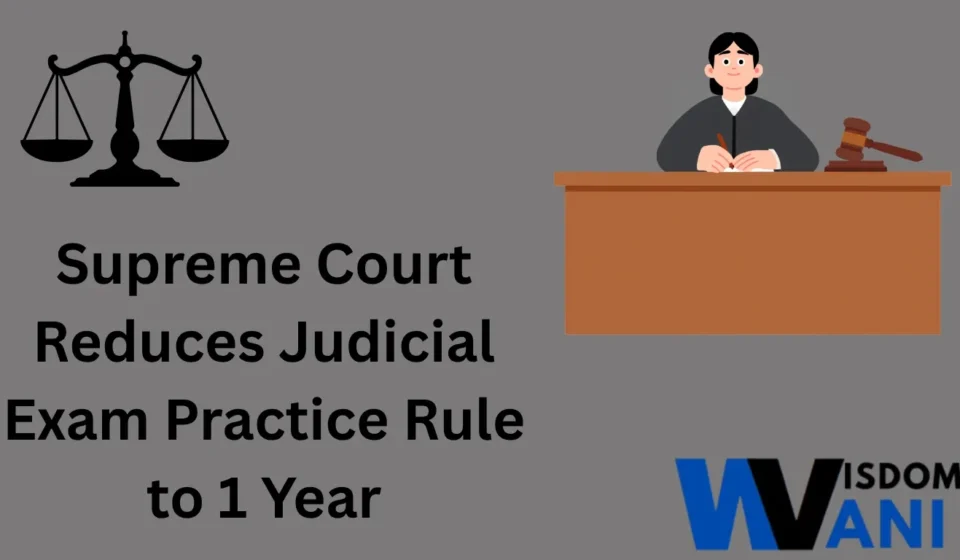
First, the Supreme Court said you need three years of practice before you can even sit for the exam. Then thousands of aspirants filed review petitions. And just yesterday — on August 21, 2026 — the Supreme Court modified that verdict. The three-year practice requirement has been reduced to one year. But it comes with conditions.
This blog breaks down the entire journey — what the original rule was, what the court decided in May 2025, why it was challenged, and what the new modified position means for you right now.
What Is the 3-Year Practice Rule?
The Rule Before 2002
For most of India’s post-independence history, you could not walk straight from your law college into a judge’s chair. States required candidates for entry-level judicial posts — Civil Judge (Junior Division), also called Munsiff-Magistrate — to have at least three years of practice as an advocate before they could even apply.
The logic was simple. A courtroom-ready judge needs more than textbook knowledge. They need to know how hearings actually run, how evidence is led, how witnesses behave, how lawyers argue. That comes from practice — not from exam scores.
The 2002 Reversal
The Supreme Court changed this in All India Judges Association v. Union of India (2002). Acting on the recommendations of the First National Judicial Pay Commission (the Shetty Commission, 1999), the Court abolished the mandatory practice requirement. Fresh law graduates could now appear in judicial exams directly after completing their degree.
The reasoning then: the five-year integrated law degree had made graduates more academically prepared than before, and requiring three years of low-paying junior practice was discouraging talented people from choosing the judiciary.
For over two decades — from 2002 to May 2025 — this “classroom-to-courtroom” pathway remained open.
The May 2025 Reinstatement
On May 20, 2025, a bench comprising Chief Justice B.R. Gavai and Justices A.G. Masih and K. Vinod Chandran delivered a landmark judgment in the same case — All India Judges Association v. Union of India, 2025 INSC 735 — and reversed the 2002 position.
The Supreme Court held that fresh law graduates cannot appear in judicial services examination, mandating a minimum three years of legal practice for candidates applying to entry-level posts.
The three-year practice rule was back.
Highlights of the Supreme Court Judgement
Core Rationale of the Court
Why did the Supreme Court reverse two decades of practice in one judgment? Three core reasons drove the bench:
- Courtroom readiness matters.The CJI stated: “The appointment of fresh law graduates has led to several difficulties, as noted by multiple high courts. Practical experience in court is essential for ensuring judicial efficiency and competence.”
- High Courts flagged problems. The Supreme Court took judicial notice of the prevailing view among High Courts and States that admission of fresh law graduates to judicial service had proven counterproductive. Multiple High Courts submitted data and observations supporting the reinstatement.
- Uniformity across states. Before the 2025 judgment, some states required prior experience and others did not. This gap of uniformity brought up constitutional issues related to equality and the independence of the judiciary. The Supreme Court used this judgment to standardise the eligibility criteria nationwide.
Conditions and Guidelines Laid Down
The May 2025 judgment was not just a headline — it came with specific operational directions:
- Three years of practice as an advocate is the minimum requirement for appearing in the Civil Judge (Junior Division) exam.
- The three years of practice starts from the date a law graduate begins practice based on provisional enrolment with the Bar Council, not from when they clear the All-India Bar Exam (AIBE).
- Experience as a law clerk to a judge will also be recognised, reflecting the value of courtroom exposure even in a non-advocate capacity.
- The three-year practice requirement must be certified and endorsed by a lawyer with at least 10 years of standing at the Bar.
- All High Courts and State Governments were directed to amend their service rules to reflect this requirement.
The August 2026 Review: Supreme Court Reduces It to 1 Year
The May 2025 judgment triggered a wave of review petitions. Thousands of aspirants who had built their entire career plans around the “no prior experience” pathway suddenly found themselves locked out.
Review petitioners argued that the experience requirement discouraged talented graduates from entering the judiciary, particularly women and graduates from leading law schools. They urged the Court to strengthen induction training and judicial education instead of insisting on litigation experience.
On August 21, 2026, the Supreme Court pronounced its verdict on those review petitions. By a 2:1 majority — Chief Justice Surya Kant and Justice A.G. Masih in the majority, Justice K. Vinod Chandran dissenting:
- The Supreme Court modified its May 2025 verdict by reducing to one year the earlier mandatory requirement of three-year legal practice for law graduates for taking entry-level judicial service examinations.
- The selected candidates will have to undergo training at the judicial academy and a further one year clerkship.
- Candidates appearing in judicial exams notified between May 25, 2025 and March 31, 2027 are eligible regardless of prior experience. Those selected under this window will be appointed as trainee judicial officers for one year with a further one year of structured clerkship.
- The Court rejected the contention that post-graduation in law (LLM) can be treated as equivalent to practice at the Bar.
- The fundamental principle — that candidates must have some exposure to the legal profession before joining the judiciary — was reaffirmed. The court only modified the duration, not the reasoning.
Impact on Young Law Graduates and Advocates
This ruling directly reshapes how fresh law graduates need to plan their careers. Here is what changes:
- One year is now enough — but it must be real practice. You cannot substitute it with an LLM or academic work. Enrol with your State Bar Council, start appearing in courts, and build an actual track record.
- Law clerking counts. If you are working as a law clerk with a sitting judge, that experience counts toward your eligibility period. This is a meaningful option for NLU graduates and others who take up clerkships immediately after graduation.
- The transition window is open until March 2027. If you are appearing in a judicial exam notified between May 2025 and March 2027, you can apply regardless of how much practice you have. But if selected, you go in as a trainee officer — not a fully appointed Civil Judge — for the first year.
- Career timelines have changed. Earlier, a student who graduated in June 2024 could appear in a judicial exam by October 2024. Under the new position, that same student needs at least one year of practice first. Plan accordingly.
- Women and people with disabilities face a harder path. Several petitioners specifically flagged that junior practice years are financially difficult, and the burden falls harder on women and candidates from marginalised backgrounds. The court acknowledged this but maintained that some practical exposure remains non-negotiable.
- Law schools will need to adapt. Universities may need to strengthen internship programmes, moot court culture, and live client clinics so that students graduate with more courtroom-ready skills — reducing the time needed to build the required practical foundation after graduation.
Summary
Here is where things stand right now, as of August 22, 2026:
- he original 3-year practice rule was restored by the Supreme Court in May 2025 (All India Judges Association v. Union of India, 2025 INSC 735).
- On August 21, 2026, the Supreme Court modified it to 1 year on review, by a 2:1 majority.
- The 1-year practice requirement must be real advocacy experience or law clerkship with a judge — certified by a senior advocate with 10+ years standing.
- Candidates applying under exam notifications between May 2025 and March 2027 can appear without prior experience, but if selected, they serve as trainee judicial officers for 1 year plus 1 year of structured clerkship.
- An LLM degree does not substitute for Bar practice.
- The core principle stands: you must have real exposure to courts before you can decide cases in one.
Frequently Asked Questions (FAQs)
Q1. Who does the 1-year practice rule (revised from 3 years) apply to?
Ans. It applies to candidates seeking direct recruitment as Civil Judge (Junior Division) — the entry-level judicial service post — across India. It does not apply to candidates for higher judicial posts, which have separate eligibility criteria. The rule applies uniformly across all states following the Supreme Court’s direction to amend State Judicial Service Rules.
Q2. Does law clerkship count as “practice” for this rule?
Ans. Yes. The Supreme Court specifically recognised that experience as a law clerk to a judge qualifies toward the practice requirement. If you worked as a law clerk for one year after graduation, that experience counts — and you can sit for the Civil Judge exam.
Q3. Where can I read the official Supreme Court orders?
Ans. May 2025 judgment: All India Judges Association v. Union of India, 2025 INSC 735 — available on the Supreme Court of India’s official website at supremecourt.gov.in and on legal databases like SCC Online and Manupatra.
August 2026 review judgment: Bhumika Trust v. Union of India — available on the same platforms. The citation is being updated on legal databases as of the date of this blog.
Q4. Can I apply if I graduated in 2024 and have not practised at all?
Ans. If the exam notification was issued between May 25, 2025 and March 31, 2027 — yes, you can apply. But if selected, you will be appointed as a trainee judicial officer for one year and will complete a further one-year structured clerkship before becoming a fully appointed Civil Judge.
Join the Conversation
The Supreme Court’s modified ruling on the practice requirement is one of the most significant developments in Indian legal education and judicial recruitment in recent years. It raises big questions that affect thousands of aspirants every year.
What do you think — does one year of practice genuinely prepare a person to be a judge?
Or should the focus be on better training programmes within the judiciary itself?
Drop your thoughts in the comments below. If you found this blog useful, share it with your batchmates and fellow judiciary aspirants — this is exactly the kind of update that can change someone’s career plan overnight.