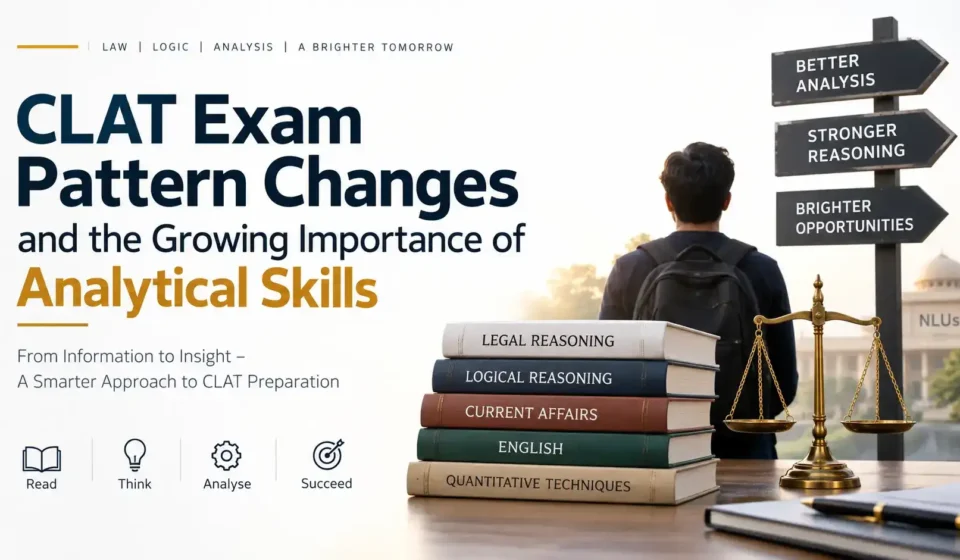

The Common Law Admission Test (CLAT) has never been an exam that rewards memorisation alone. But in recent years, the way students approach the test has started to change. Reading a passage carefully, understanding an argument and applying a principle can matter just as much as remembering facts.
This discussion has become more relevant after the CLAT Expert Committee Report 2026. The Consortium of National Law Universities created the committee to review areas such as question quality, paper structure, syllabus and comparable law entrance examinations.
At the same time, students preparing for CLAT 2027 should not confuse proposed reforms with the current examination pattern. The Consortium has continued to publish the existing CLAT structure for the 2027 examination.
So, what should students actually prepare for, and why are analytical skills for CLAT becoming so important?
What Is the CLAT 2027 Exam Pattern?
For CLAT 2027, the examination continues to follow the familiar five-section structure:
- English Language
- Current Affairs, including General Knowledge
- Legal Reasoning
- Logical Reasoning
- Quantitative Techniques
The UG examination will take place on December 6, 2026, from 2 PM to 4 PM, according to the current official schedule. The exam will be conducted in offline mode.
The paper continues to test different abilities rather than one particular type of knowledge. English and reasoning sections require students to work with passages and arguments, while Legal Reasoning asks them to apply principles to given situations. Current Affairs tests awareness of important developments, and Quantitative Techniques checks basic numerical and data-related ability.
This combination makes CLAT different from a purely memory-based examination.
Why Is Analytical Ability Becoming More Important?
Consider a simple situation.
You read a passage about freedom of speech. The passage explains a particular principle and then gives an example involving a person’s statement.
The question does not necessarily ask you to remember a constitutional provision word for word. Instead, it may ask whether the facts in the example support a particular conclusion.
That requires a different kind of preparation.
You need to:
- Understand what the passage says
- Identify the main issue
- Separate relevant facts from unnecessary details
- Connect the principle with the facts
- Eliminate options that do not follow from the passage
This is what makes analytical reasoning in CLAT important.
A student can know a lot of information and still struggle if they cannot use that information when a question presents it in an unfamiliar way.
The Expert Committee Has Started a Bigger Conversation
The Consortium’s Expert Committee was formed to examine the quality and structure of CLAT and suggest medium- and long-term reforms. Its terms of reference specifically included question quality, paper structure, syllabus and comparison with examinations such as LSAT and LNAT.
The report has therefore brought attention to an important question:
What should a law entrance examination actually measure?
Should students mainly remember information?
Or should the examination place more emphasis on how they read, reason and solve unfamiliar problems?
The committee’s recommendations discuss changes that could increase the role of aptitude, comprehension and reasoning in future versions of CLAT.
However, students should keep one distinction clear. A recommendation is not automatically an examination rule. Unless the Consortium officially changes the pattern for a particular year, aspirants should prepare according to that year’s official notification.
For CLAT 2027, the existing pattern remains the relevant one.
Legal Reasoning Is About Application, Not Memorisation
Legal Reasoning often creates confusion among students because the word “legal” makes the section sound more difficult than it actually is.
You do not need to know the entire law syllabus taught in a law school.
Instead, many questions give you a principle or a legal situation and ask you to work out the answer from the information provided.
For example, imagine a question gives you a rule concerning negligence. It then describes an accident caused after someone ignored an obvious safety warning.
Your task is not to search your memory for a Supreme Court judgment.
You need to understand the rule and apply it to the facts.
That involves a simple chain of thinking:
Rule → Facts → Application → Conclusion
The more comfortable you become with this process, the easier unfamiliar Legal Reasoning questions can feel.
Logical Reasoning Tests the Way You Read Arguments
Logical Reasoning presents a similar challenge.
A question may give you an argument and ask about its assumption, conclusion, inference or strength.
The difficult part is often not understanding the individual words. The difficult part is seeing the relationship between the ideas.
Suppose someone argues that students who read newspapers regularly understand current affairs better.
You might be asked what assumption supports that argument.
The answer may not appear as a direct sentence in the passage. You have to identify the missing link that makes the argument work.
That is why simply solving hundreds of questions without understanding the reasoning behind them may not produce much improvement.
After every question, ask yourself:
Why is this option correct, and why are the other options wrong?
That habit can gradually sharpen your reasoning.
Reading Comprehension Has Become a Core Skill
Many CLAT aspirants still approach English mainly through vocabulary lists and grammar rules.
Those areas can help, but they are not enough.
A student can know the meaning of every word in a passage and still misunderstand the author’s argument.
CLAT preparation therefore needs regular reading practice.
Read newspaper editorials, legal developments, opinion articles and serious non-fiction. Then pause for a moment and identify the central point.
Try asking:
- What is the writer actually arguing?
- What evidence does the writer use?
- Is the argument based on an assumption?
- Which statement best represents the passage?
- What conclusion can reasonably follow?
This turns ordinary reading into CLAT reading comprehension practice.
You are no longer just reading words. You are following an argument.
Current Affairs Still Has an Important Role
The discussion about analytical skills should not lead students to ignore Current Affairs.
For CLAT 2027, Current Affairs and General Knowledge remain part of the official examination structure.
The better approach is to understand important events instead of collecting endless one-line facts.
For instance, if you study an important Supreme Court judgment, don’t stop after learning the case name.
Try to understand:
- What issue came before the Court?
- What arguments did the parties raise?
- Which legal principle mattered?
- What did the Court decide?
- Why did the judgment attract attention?
This method also makes revision easier because you connect facts with a larger story.
The same approach works for international affairs, government policies, major economic developments and important legal changes.
Quantitative Techniques Also Requires Clear Thinking
Quantitative Techniques carries a smaller portion of the CLAT paper, but students should not ignore it.
The section can involve areas such as percentages, ratios, averages and data interpretation.
Here too, understanding the concept matters.
Suppose a question gives you a table containing information about the population of several cities. You may know how to calculate a percentage, but you still need to understand which numbers the question actually wants you to compare.
So, don’t practise formulas in isolation.
Work with different types of questions and learn how to identify the information that matters.
How Students Can Build Analytical Skills for CLAT
Analytical ability does not develop overnight. But students can build it through small daily habits.
Read for 20–30 Minutes
Choose one quality article every day. Focus on understanding the argument instead of simply finishing the article.
Summarise What You Read
After reading, explain the article in two or three sentences.
If you cannot summarise it, you probably need to read it again.
Question the Argument
Ask yourself whether the writer’s conclusion actually follows from the evidence.
You don’t have to agree or disagree. The exercise is about understanding the reasoning.
Practise Passage-Based Questions
While solving CLAT questions, avoid looking for familiar words alone. Read the complete question and understand what it actually asks.
Analyse Your Mistakes
A mock test becomes useful when you study the mistakes afterward.
Keep track of:
- Questions you misunderstood
- Careless mistakes
- Questions that took too long
- Guesswork
- Topics that repeatedly cause problems
Over time, this gives you a clearer picture of your preparation.
What Should CLAT 2027 Aspirants Do Now?
Students preparing for CLAT 2027 should not completely change their preparation strategy because of the Expert Committee’s recommendations.
The official CLAT 2027 information should remain the primary source for preparation. The Consortium itself advises candidates to regularly check the CLAT 2027 website for updates.
At the same time, improving analytical skills is useful even within the existing pattern.
Focus on:
- Reading comprehension
- Legal reasoning
- Logical reasoning
- Current affairs
- Quantitative concepts
- Passage-based practice
- Mock tests
- Time management
- Detailed error analysis
Most importantly, don’t turn your preparation into a race to memorise more and more information.
Try to understand what you are reading.
The Real Change May Be in the Way Students Prepare
The discussion around the CLAT Expert Committee Report 2026 highlights something that students should already be thinking about.
Law is not simply about remembering sections, definitions or case names. A law student has to read complicated material, identify issues, compare arguments and apply legal principles to facts.
CLAT tests some of those abilities at the entrance stage.
The exact structure of the examination may change in the future. The Consortium will decide which recommendations, if any, it adopts for subsequent editions.
For now, students should prepare for the officially announced CLAT 2027 pattern while developing a stronger habit of reading and reasoning.
Don’t just ask, “What is the answer?”
Ask yourself:
“How did I reach the answer?”
That shift in approach can make CLAT preparation more meaningful—and it prepares students for the kind of thinking they will need once they enter law school.