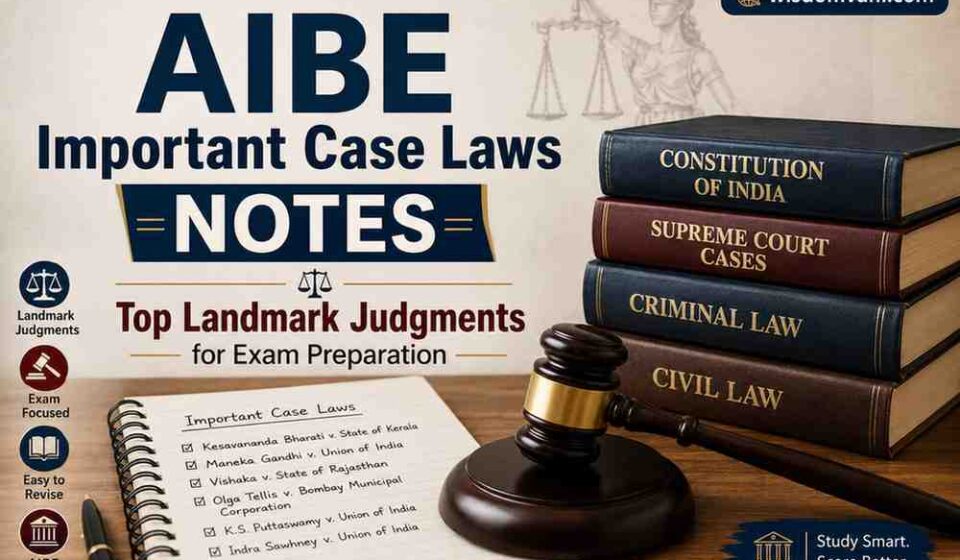

Preparing for AIBE?
These landmark case laws are your ultimate weapon!
From Fundamental Rights to Criminal Law, these cases explain the core principles every law student must remember. If you master these, you won’t just pass AIBE — you’ll understand the law like a pro.
CRIMINAL LAW & PROCEDURE
- Nandini Satpathy v. P.L. Dani (1978)The right against self-incrimination includes the right to remain silent during the investigation.
- Pooja Pal v. Union of India (2016)A fair investigation is considered an integral part of the rights guaranteed under Article 21.
- Lalita Kumari v. Government of Uttar Pradesh (2014)It is mandatory for the police to register an FIR in cases involving cognizable offences.
- R.P. Kapur v. State of Punjab (1960)The Court’s inherent powers should be exercised sparingly and only to prevent the abuse of the legal process.
- Joginder Kumar v. State of Uttar Pradesh (1994)Arrest must not be automatic; it must be justified and based on necessity.
- Arnesh Kumar v. State of Bihar (2014)Guidelines were established to prevent the misuse of arrest in matrimonial offences, specifically under Section 498A of the IPC.
- Vinay Tyagi v. Irshad Ali (2013)A Magistrate has the authority to order further investigation even after a chargesheet has been filed.
- D.K. Basu v. State of West Bengal (1997)Custodial torture is a violation of Article 21; the court laid down specific guidelines to be followed during an arrest.
- State of Haryana v. Bhajan Lal (1992)The court defined the specific conditions and circumstances under which an FIR can be quashed.
- Hussainara Khatoon v. State of Bihar (1979)The right to a speedy trial is recognized as a fundamental right under Article 21.
LAW OF EVIDENCE
- Sharad Birdhichand Sarda v. State of Maharashtra (1984) The Supreme Court established the “Panchsheel” (5 golden principles) that must be met to base a conviction solely on circumstantial evidence.
- Khushal Rao v. State of Bombay (1958) It was held that a dying declaration can form the sole basis of a conviction without corroboration, provided it is found to be true and voluntary.
- Laxman v. State of Maharashtra (2002) The Court clarified that a doctor’s certificate regarding the fitness of the declarant is not an absolute necessity if the court is otherwise satisfied that the victim was in a fit mental state to make a statement.
- Sat Paul v. Delhi Administration (1976) The testimony of a hostile witness is not entirely rejected; the parts of the statement that are consistent with the case and found reliable can still be used by the court.
- Dharam Deo Yadav v. State of Uttar Pradesh (2014) This case emphasized that scientific evidence, such as DNA profiling and forensic reports, carries high probative value in the modern criminal justice system.
- Pulukuri Kottaya v. Emperor (1947) A landmark case on Section 27 of the Evidence Act, establishing that only the “distinct information” which leads directly to the discovery of a fact is admissible, even if the rest of the confession is excluded.
CONTRACT LAW
- Mohori Bibee v. Dharmodas Ghose (1903)
Agreement with minor is void from the beginning. - Balfour v. Balfour (1919)
Domestic agreements lack intention to create legal relations. - Carlill v. Carbolic Smoke Ball Co. (1893)
General offer can be accepted by anyone fulfilling conditions. - Hyde v. Wrench (1840)
Counter-offer cancels original offer. - Felthouse v. Bindley (1862)
Silence does not amount to acceptance.
CONSTITUTIONAL LAW
- Kesavananda Bharati v. State of Kerala (1973)
Parliament can amend the Constitution, but it cannot alter its basic structure. - Maneka Gandhi v. Union of India (1978)
Article 21 includes fair, just, and reasonable procedure, not arbitrary law. - Justice K.S. Puttaswamy v. Union of India (2017)
Right to Privacy is a fundamental right under Article 21. - Bhikaji Narain Dhakras v. State of Madhya Pradesh (1955)
Laws violating Fundamental Rights are inactive (eclipsed), not void. - State of Mysore v. Venkataramana (1958)
Constitutional provisions should be interpreted harmoniously, not in conflict. - Minerva Mills Ltd. v. Union of India (1980)
Judicial review and balance between FR & DPSP are basic features. - State of Bombay v. F.N. Balsara (1951)
Introduced Doctrine of Pith and Substance to determine true nature of law. - Olga Tellis v. Bombay Municipal Corporation (1985)
Right to livelihood is an essential part of right to life. - Shreya Singhal v. Union of India (2015)
Struck down vague laws restricting freedom of speech (Section 66A IT Act). - Ajay Hasia v. Khalid Mujib Sehravardi (1981)
State includes government-controlled bodies and agencies. - Sukhdev Singh v. Bhagatram (1975)
Public corporations performing state functions fall under Article 12. - Rajasthan State Electricity Board v. Mohan Lal (1967)
Statutory authorities are considered “State” under Article 12. - K.C. Gajapati Narayan Deo v. State of Orissa (1953)
Doctrine of Colourable Legislation: law cannot do indirectly what it cannot do directly. - S.R. Bommai v. Union of India (1994)
Secularism is part of the basic structure of the Constitution. - State of West Bengal v. Union of India (1963)
Indian Constitution establishes a federal structure. - Golaknath v. State of Punjab (1967)
Fundamental Rights cannot be amended; introduced prospective overruling.
INDIAN PENAL CODE / BNS
- Mahbub Shah v. King Emperor (1945)
Common intention requires pre-arranged plan and participation. - State of Uttar Pradesh v. Babu Ram (2000)
Motive is helpful but not essential for conviction. - K.M. Nanavati v. State of Maharashtra (1962)
Explained grave and sudden provocation in murder cases. - Reg v. Govinda (1876)
Clarified difference between murder and culpable homicide. - Virsa Singh v. State of Punjab (1958)
Established test for intention in murder cases. - Iridium India Telecom Ltd. v. Motorola Inc. (2011)
Companies can be held criminally liable. - Basdev v. State of Pepsu (1956)
Voluntary intoxication is not a defense. - S.S. Chheena v. Vijay Kumar (2010)
Abetment requires active involvement, not mere silence.
CIVIL PROCEDURE CODE (CPC)
- Daryao v. State of Uttar Pradesh (1961)
Res judicata applies to writ petitions also. - Forward Construction Co. v. Prabhat Mandal (1986)
Constructive res judicata prevents re-litigation of issues. - Kiran Singh v. Chaman Paswan (1954)
Jurisdiction cannot be created by consent. - Dalpat Kumar v. Prahlad Singh (1992)
Temporary injunction requires prima facie case + balance of convenience + irreparable injury.
NEGOTIABLE INSTRUMENTS ACT
- Rangappa v. Sri Mohan (2010)
Cheque presumed to be for legally enforceable debt. - C.C. Alavi Haji v. Palapetty Muhammed (2007)
Notice is valid even if not personally received.
PROPERTY LAW
- Suraj Lamp & Industries Pvt. Ltd. v. State of Haryana (2011)
Property transfer through GPA is invalid. - Nathulal v. Phoolchand (1969)
Doctrine of part performance protects possession without registration.
ARBITRATION LAW
- Vidya Drolia v. Durga Trading Corporation (2020)
Arbitrator has power to decide jurisdiction first. - McDermott International Inc. v. Burn Standard Co. Ltd. (2006)
Courts can only set aside awards on limited grounds.
FAMILY LAW
- Mohd. Ahmed Khan v. Shah Bano Begum (1985)
Muslim women entitled to maintenance under criminal law. - Danial Latifi v. Union of India (2001)
Maintenance must be fair and reasonable beyond iddat period. - Vineeta Sharma v. Rakesh Sharma (2020)
Daughters have equal coparcenary rights. - Sarla Mudgal v. Union of India (1995)
Conversion cannot be used to justify second marriage.
TORT LAW
- Donoghue v. Stevenson (1932)
Established duty of care (neighbour principle). - Rylands v. Fletcher (1868)
Introduced strict liability rule. - M.C. Mehta v. Union of India (1987)
Established absolute liability (no exceptions).
PUBLIC INTEREST LITIGATION (PIL)
- S.P. Gupta v. Union of India (1981)
Expanded locus standi for PIL. - Janata Dal v. H.S. Chowdhary (1992)
PIL cannot be used for personal or political motives. - M.C. Mehta v. Union of India
Environmental protection is part of Article 21.