Intellectual Property Rights: Concepts, Nature, Principles, and Objectives

In today’s innovation-led economy, the real value often lies not in physical goods but in the ideas, expressions, and identifiers that drive progress. Intellectual property rights (IPR) provide the legal structure that recognises and protects these intangible creations. They give creators and businesses temporary exclusive control while ensuring that knowledge eventually becomes available for wider use. India’s framework, built on the Patents Act, 1970 (as amended), the Copyright Act, 1957, and the Trade Marks Act, 1999, has evolved to meet both global standards under the TRIPS Agreement and local developmental needs.
The Basic Concept of Intellectual Property Rights
IPR refers to the legal entitlements granted over the products of human intellect once those products take a concrete form. Protection does not extend to abstract ideas themselves; it applies only when ideas are expressed or embodied in a tangible or identifiable manner.
Key features of this concept include:
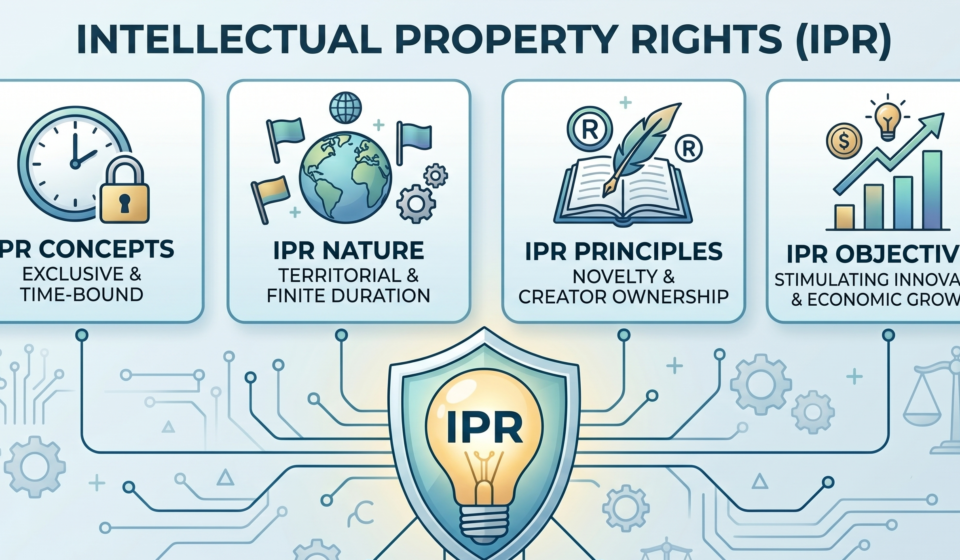
- Exclusive but time-bound control: The rights holder can decide who may reproduce, distribute, adapt, sell, or commercially exploit the creation. This control lasts only for a defined period, after which the work enters the public domain.
- Two broad categories of protection: Copyright and related rights cover original literary, artistic, musical, and dramatic works, including software, films, and performances. These rights generally arise automatically upon creation, although registration strengthens the ability to enforce them in court. Industrial property, on the other hand, includes patents for inventions that meet the tests of novelty, inventive step, and industrial applicability; trademarks that distinguish the goods or services of one enterprise from those of others; industrial designs that protect the aesthetic appearance of products; geographical indications that link specific qualities of a product to its place of origin; and trade secrets that protect commercially valuable confidential information.
- Requirement of fixation or registration: Pure concepts or discoveries remain unprotected. A working prototype, a written manuscript, a registered design, or a properly maintained trade secret is necessary before legal rights can be claimed. This distinction prevents overbroad monopolies while rewarding those who convert ideas into usable or marketable forms.
- International foundation with national implementation: Early systems appeared in Renaissance Europe. Today, treaties administered by the World Intellectual Property Organization (WIPO), such as the Berne Convention and the Paris Convention, together with the TRIPS Agreement, set minimum standards that member countries must follow while allowing flexibility to address domestic priorities.
The Distinctive Nature of Intellectual Property Rights
What sets IPR apart from ordinary property is its intangible character. A patent exists as a legal document and a set of enforceable claims; the underlying invention may be a chemical process or an algorithm. This intangibility does not reduce its economic importance. For many technology companies and creative enterprises, patents, copyrights, and trademarks constitute their most valuable assets.
Several traits define the nature of these rights:
- Negative rights with clear limits: IPR primarily gives the owner the power to prevent others from using the protected subject matter without permission. The owner is not obliged to exploit the right personally and may instead license it for royalties. At the same time, the system includes built-in safeguards such as fair use or fair dealing provisions in copyright, experimental use exceptions in patents, and compulsory licensing in cases of public interest, such as public health emergencies.
- Strict territorial scope: A patent or trademark granted in India has no automatic effect in another country. Protection must be sought separately in each jurisdiction, although mechanisms like the Patent Cooperation Treaty (PCT) simplify the process of filing in multiple countries. This territorial principle reflects national sovereignty while international agreements promote minimum harmonisation and the national treatment of foreign right holders.
- Limited duration: Protection does not last forever. In India, copyright generally endures for the author’s lifetime plus sixty years. Patent protection runs for twenty years from the filing date, subject to payment of renewal fees. Trademarks can be renewed indefinitely provided they remain in use and distinctive. Once the term expires, the creation becomes freely available for anyone to use or build upon.
- Transferability and licensability: Rights can be sold, assigned, or licensed to others. A musician may license a composition for use in a film; a startup may assign a patent portfolio to a larger company. Certain moral rights, such as the right to be identified as the author, often remain with the creator and cannot be transferred.
- Enforcement challenges: Because the subject matter is intangible, detecting and proving infringement can be difficult. Counterfeiting, software piracy, and unauthorised digital reproduction remain persistent problems. Advances in digital tracking, blockchain-based registries, and international cooperation are gradually improving enforcement outcomes.
Core Principles Guiding Intellectual Property Rights
IPR systems worldwide operate on a set of consistent principles that balance incentives for creators with broader societal interests. These principles are embedded in Indian legislation and international treaties.
- Creator ownership as the default rule: The person who originates the work or invention is generally recognised as the first owner. Exceptions exist, notably in employment relationships where the employer may own rights created in the course of duty. This principle encourages individuals and firms to invest time and resources in creative and inventive activity.
- Novelty, originality, and distinctiveness requirements: Protection is not granted automatically to every output. Patents require an invention to be new, involve a non-obvious inventive step, and be industrially applicable. Copyright protects original expression rather than ideas themselves. Designs must display aesthetic novelty, and trademarks must be capable of distinguishing goods or services. These thresholds filter out trivial or pre-existing material.
- Territoriality combined with international minimum standards: Rights are granted and enforced within national borders. Treaties such as TRIPS impose obligations on member states to provide certain levels of protection and to treat foreign nationals no less favourably than their own citizens (national treatment). The most-favoured-nation principle further ensures non-discriminatory treatment among trading partners.
- Finite protection to serve the public interest: By limiting the duration of exclusive rights, the system creates a social contract: creators receive temporary exclusivity in exchange for eventual public access. Expired patents, for example, enable generic manufacturers to produce affordable medicines, while expired copyrights enrich the cultural commons.
- Balancing private reward with public access: Provisions for fair use, experimental use, compulsory licensing, and exclusions for subject matter such as traditional knowledge or discoveries reflect a deliberate effort to prevent IPR from unduly restricting access to essential knowledge or technologies.
- Non-discrimination, transparency, and moral rights: Laws generally avoid unjustified discrimination between different fields of technology. Registration procedures are expected to be transparent. In copyright, moral rights protect the personal connection between creator and work. In trademark law, the requirement of distinctiveness prevents consumer confusion in the marketplace.
Primary Objectives of Intellectual Property Rights
Societies establish IPR systems to achieve several interconnected goals that extend beyond the protection of individual creators.
- Stimulating innovation and creativity: The promise of exclusive rights reduces the risk that others will copy an invention or work without compensation. This incentive encourages investment in research and development across pharmaceuticals, information technology, agriculture, and the creative industries.
- Providing economic incentives and rewards: Creators and innovators can monetise their efforts through direct sales, licensing, or royalties. This recognition of intellectual labour sustains continued creative and inventive output over time.
- Supporting economic growth and development: Robust IPR regimes attract foreign direct investment, facilitate technology transfer, and create employment in knowledge-intensive sectors. In India, a credible IPR framework underpins initiatives such as “Make in India” by assuring international partners that their innovations will receive protection. Strong brands and geographical indications also enable exporters to command premium prices in global markets.
- Promoting fair competition and consumer protection: Trademarks and geographical indications help consumers identify genuine products and prevent deception. By rewarding quality and reputation rather than imitation, these rights level the competitive playing field.
- Facilitating the dissemination of knowledge: Patent systems require public disclosure of inventions, creating a growing repository of technical information that others can study and improve upon. Copyright, once its term expires, adds to the shared cultural heritage available to all.
- Preserving cultural heritage and enabling social progress: Geographical indications and sui generis systems for traditional knowledge help protect products and practices tied to specific communities and regions. At the same time, the framework allows for modern adaptations and commercialisation that can benefit those communities economically.
Why IPR Remains Essential in 2026 and Beyond
Rapid developments in artificial intelligence, biotechnology, digital content, and green technologies have made effective intellectual property protection more relevant than ever. These fields generate valuable intangible assets that require clear rules to encourage investment while addressing new questions around authorship, inventorship, and access.
For startups, researchers, writers, designers, and established businesses, understanding IPR is now a strategic necessity rather than a legal formality. Timely trademark registration, careful patent filing strategies, proper copyright management, and respect for others’ rights can prevent costly disputes and open avenues for licensing and collaboration. In India and internationally, a well-functioning IPR system does not hoard knowledge; it structures its creation, temporary protection, and eventual release for collective benefit.
The next time you encounter a “patent pending” notice, a registered geographical indication on a food product, or a protected creative work, recognise the underlying architecture: a deliberate legal design that rewards human ingenuity today so that society can build upon it tomorrow.