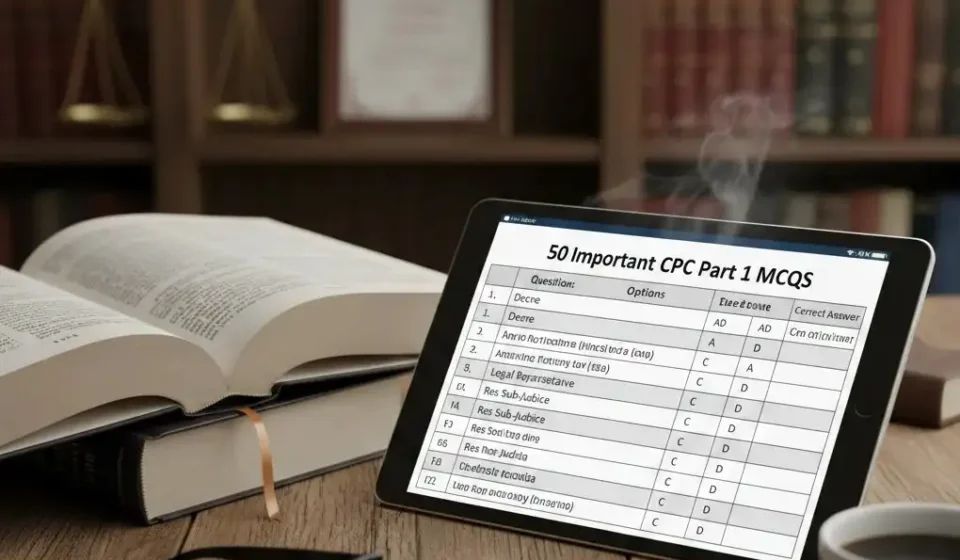

| No. | Question | Options (A, B, C, D) | Correct Answer |
| 1 | The Code of Civil Procedure, 1908, came into force on? | A) 1st Jan 1908, B) 1st Jan 1909, C) 1st April 1909, D) 31st Dec 1908 | B |
| 2 | Which section of the CPC defines a “Decree”? | A) Section 2(1), B) Section 2(2), C) Section 2(6), D) Section 2(14) | B |
| 3 | A decree can be: | A) Final, B) Preliminary, C) Partly preliminary and partly final, D) All of the above | D |
| 4 | “Legal Representative” is defined under which section? | A) Section 2(11), B) Section 2(12), C) Section 2(2), D) Section 2(10) | A |
| 5 | “Mesne profits” means those profits which the person in wrongful possession: | A) Actually received, B) Might with ordinary diligence have received, C) Both A & B, D) Only A | C |
| 6 | A “Foreign Judgment” means a judgment of: | A) A Court outside India, B) A Court not established by Central Govt, C) Both A & B, D) High Court | C |
| 7 | Which section deals with the “Pecuniary Jurisdiction” of Courts? | A) Section 5, B) Section 6, C) Section 9, D) Section 10 | B |
| 8 | Courts shall try all civil suits unless barred. This is provided in: | A) Section 7, B) Section 8, C) Section 9, D) Section 11 | C |
| 9 | The principle of “Stay of Suit” is also known as: | A) Res Judicata, B) Res Sub-Judice, C) Caveat, D) Estoppel | B |
| 10 | Section 10 of the CPC deals with: | A) Res Judicata, B) Stay of Suit, C) Place of Suing, D) Summons | B |
| 11 | The doctrine of “Res Judicata” is contained in: | A) Section 10, B) Section 11, C) Section 12, D) Section 13 | B |
| 12 | How many explanations are attached to Section 11 (Res Judicata)? | A) 5, B) 6, C) 8, D) 10 | C |
| 13 | “Constructive Res Judicata” is explained in which explanation of Section 11? | A) Expl. II, B) Expl. IV, C) Expl. VI, D) Expl. VIII | B |
| 14 | Res Judicata applies to: | A) Suits only, B) Execution proceedings only, C) Both Suits and Execution, D) Arbitration only | C |
| 15 | A foreign judgment is not conclusive if: | A) Not pronounced by competent court, B) Obtained by fraud, C) Sustains a claim on breach of Indian law, D) All of the above | D |
| 16 | Under Section 15, every suit shall be instituted in: | A) Any Court, B) The High Court, C) The Court of lowest grade competent to try it, D) The District Court | C |
| 17 | Suit for immovable property shall be instituted where: | A) Subject matter is situated, B) Defendant resides, C) Plaintiff resides, D) Anywhere in India | A |
| 18 | Section 18 deals with the place of institution of suit where: | A) Property is movable, B) Local limits of jurisdiction of Courts are uncertain, C) Defendant is a foreigner, D) None | B |
| 19 | Compensation for wrong to person or movables is dealt with under: | A) Section 18, B) Section 19, C) Section 20, D) Section 21 | B |
| 20 | Objection to jurisdiction must be taken at: | A) First instance, B) Appellate stage, C) Execution stage, D) Any time | A |
| 21 | The Power of Supreme Court to transfer suits is under: | A) Section 24, B) Section 25, C) Section 26, D) Section 22 | B |
| 22 | A suit is instituted by the presentation of a: | A) Plaint, B) Application, C) Affidavit, D) Written Statement | A |
| 23 | Section 27 deals with: | A) Discovery, B) Summons to Defendant, C) Summons to Witness, D) Judgment | B |
| 24 | The maximum fine for default under Section 32 for summons is: | A) Rs. 500, B) Rs. 1000, C) Rs. 5000, D) Rs. 2000 | C |
| 25 | “Judgment” is defined in Section: | A) 2(2), B) 2(9), C) 2(10), D) 2(14) | B |
| 26 | Under Section 34, the court can award interest from the date of suit to the date of decree at: | A) 6% p.a., B) 9% p.a., C) 12% p.a., D) Reasonable rate | D |
| 27 | Costs for causing delay are dealt with under: | A) Section 35, B) Section 35A, C) Section 35B, D) Section 34 | C |
| 28 | Compensatory costs in case of false or vexatious claims are limited to: | A) Rs. 1000, B) Rs. 3000, C) Rs. 5000, D) Rs. 10,000 | B |
| 29 | Which of the following is NOT a decree? | A) Rejection of a plaint, B) Dismissal for default, C) Final Order, D) Preliminary Order | B |
| 30 | A person against whom a decree has been passed is called: | A) Decree-holder, B) Judgment-debtor, C) Plaintiff, D) Appellant | B |
| 31 | “Order” is defined under Section: | A) 2(2), B) 2(14), C) 2(12), D) 2(18) | B |
| 32 | A person who sues is called: | A) Defendant, B) Respondent, C) Plaintiff, D) Petitioner | C |
| 33 | Jurisdiction of Civil Courts can be: | A) Territorial, B) Pecuniary, C) Subject-matter, D) All of the above | D |
| 34 | The rule of Res Sub-Judice implies: | A) Stay of subsequent suit, B) Dismissal of suit, C) Transfer of suit, D) Review of suit | A |
| 35 | Does Res Judicata apply between co-defendants? | A) Yes, always, B) No, never, C) Yes, if necessary to decide the case, D) Only in criminal cases | C |
| 36 | Section 13 of CPC deals with: | A) Indian Judgments, B) Foreign Judgments, C) Summons, D) Costs | B |
| 37 | Presumption as to Foreign Judgments is given in: | A) Section 13, B) Section 14, C) Section 15, D) Section 16 | B |
| 38 | Section 20 is a: | A) Residuary provision, B) Specific provision, C) Mandatory provision, D) None | A |
| 39 | A suit for rent of immovable property should be filed: | A) Where property is situated, B) Where defendant resides, C) Where plaintiff works, D) Any of these | A |
| 40 | Power of High Court to transfer suits is under Section: | A) 23, B) 24, C) 25, D) 26 | B |
| 41 | Section 26(2) states that in every plaint, facts shall be proved by: | A) Documents, B) Oral evidence, C) Affidavit, D) Witnesses | C |
| 42 | Summons to the defendant must be served within: | A) 30 days, B) 60 days, C) 90 days, D) 15 days | A |
| 43 | Which section deals with “Interest”? | A) Section 33, B) Section 34, C) Section 35, D) Section 36 | B |
| 44 | General provisions regarding “Costs” are in: | A) Section 34, B) Section 35, C) Section 35A, D) Section 38 | B |
| 45 | Section 35A deals with: | A) General Costs, B) Compensatory Costs, C) Delay Costs, D) Pre-litigation Costs | B |
| 46 | The “District” is defined in Section: | A) 2(1), B) 2(4), C) 2(8), D) 2(15) | B |
| 47 | “Judge” means the presiding officer of a: | A) High Court, B) Civil Court, C) Supreme Court, D) All of the above | B |
| 48 | Can a decree be both preliminary and final? | A) Yes, B) No, C) Only in partition suits, D) Only in mortgage suits | A |
| 49 | The term “Public Officer” is defined in Section: | A) 2(11), B) 2(17), C) 2(18), D) 2(20) | B |
| 50 | Res Judicata does not apply to: | A) Civil suits, B) Writ of Habeas Corpus, C) Execution proceedings, D) Probate proceedings | B |