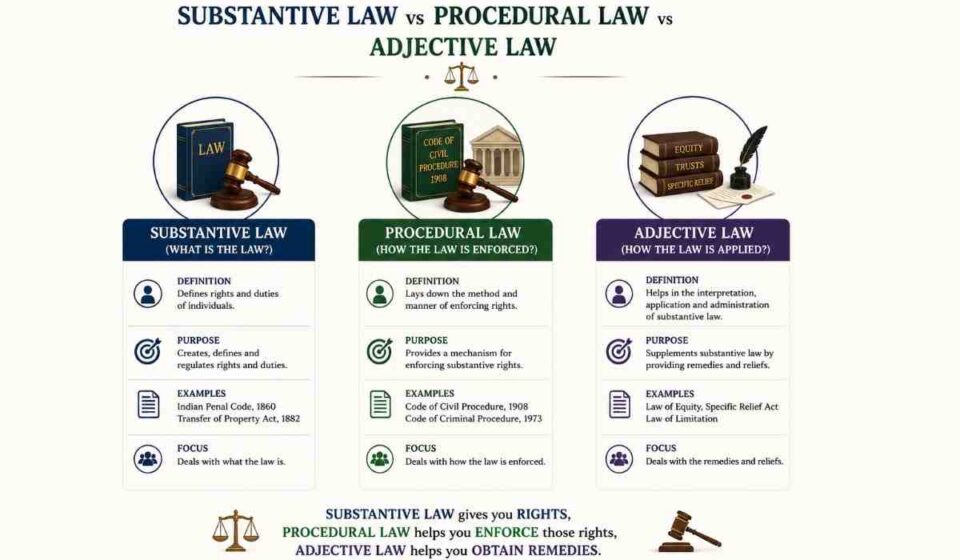
Substantive Law vs Procedural Law vs Adjective Law: Complete Guide with Examples for Law Students

Introduction
Every law student comes across three important terms in the very beginning of their legal studies — Substantive Law, Procedural Law, and Adjective Law. These three together form the foundation of how the legal system works in India.
Many students get confused between these terms because they often overlap. However, each has a distinct role. Substantive law tells us what is right and what is wrong. Procedural law tells us how to enforce those rights. And Adjective law is a special part of procedural law that deals specifically with rules of evidence.
In this article, we will understand all three in simple language with clear examples, especially keeping in mind the Indian legal system and the new criminal laws (BNS, BNSS, and BSA) that came into effect from July 2024.
What is Substantive Law?
Substantive Law is the law that defines the rights, duties, and liabilities of individuals. It tells us what acts are legal and what acts are illegal. It creates the actual rules that govern our daily life and relationships.
In simple words:
Substantive law answers the question — “What is right and what is wrong?”
Key Features of Substantive Law:
- It creates rights and obligations.
- It defines offences and prescribes punishments.
- It deals with the subject matter of the dispute.
- It is the main law that people usually refer to in daily life.
Examples of Substantive Law:
| Law | What it Defines | Example |
|---|---|---|
| Bharatiya Nyaya Sanhita (BNS), 2023 (earlier IPC) | Defines crimes and punishments | Section 103 BNS defines murder and its punishment |
| Indian Contract Act, 1872 | Defines valid contracts and remedies | What makes a contract valid or void |
| Hindu Marriage Act, 1955 | Defines conditions of valid marriage | Prohibited degrees of relationship |
| Transfer of Property Act, 1882 | Defines rights related to property | Rules of sale, mortgage, lease |
Real-Life Example: If “A” kills “B”, the Bharatiya Nyaya Sanhita says that this act is wrong and prescribes punishment for murder. This is substantive law because it defines the offence and the liability.
What is Procedural Law?
Procedural Law lays down the procedure or method through which substantive rights are enforced in a court of law. It tells us how a case should be filed, investigated, tried, and decided.
In simple words:
Procedural law answers the question — “How to get justice?”
It does not create any new rights. It only provides the machinery to enforce the rights already created by substantive law.
Key Features of Procedural Law:
- It deals with the process of litigation.
- It includes rules of filing cases, investigation, trial, appeal, etc.
- It ensures fair procedure is followed.
- It is also called “adjective law” in a broad sense, but not entirely.
Examples of Procedural Law:
| Law | What it Deals With | Example |
|---|---|---|
| Bharatiya Nagarik Suraksha Sanhita (BNSS), 2023 (earlier CrPC) | Criminal procedure | How to file FIR, how to get bail, how trial is conducted |
| Code of Civil Procedure (CPC), 1908 | Civil procedure | How to file a civil suit, how to serve summons |
| Limitation Act, 1963 | Time limit to file cases | Within how many years a case must be filed |
Real-Life Example: If someone commits murder, the Bharatiya Nyaya Sanhita tells us it is a crime. But the Bharatiya Nagarik Suraksha Sanhita tells us how the police will investigate, how the charge sheet will be filed, how the trial will take place, and how the accused can get bail. This entire process is procedural law.
What is Adjective Law?
Adjective Law is a branch of procedural law that specifically deals with the rules of evidence. It tells us how to prove facts in a court of law.
The term “adjective law” comes from the idea that it is attached to substantive law like an adjective describes a noun. It does not create any rights or liabilities by itself. It only provides the method of proving those rights or liabilities.
Important Point:
All adjective law is procedural law, but not all procedural law is adjective law.
Why is the Evidence Act called Adjective Law?
The Bharatiya Sakshya Adhiniyam (BSA), 2023 (earlier Indian Evidence Act, 1872) is considered a classic example of adjective law because:
- It does not create any rights or liabilities.
- It only prescribes how to prove facts in court.
- It deals with relevancy, admissibility, and burden of proof.
- It governs the process of judicial fact-finding.
Examples of matters covered under Adjective Law (Evidence Act):
- Which documents can be admitted as evidence?
- How to examine a witness?
- When can electronic records (CCTV, WhatsApp chats) be used as evidence?
- What is the burden of proof in criminal and civil cases?
- Which facts are relevant and which are not?
Clear Difference Between Substantive, Procedural and Adjective Law
Here is a simple comparison table:
| Basis | Substantive Law | Procedural Law | Adjective Law |
|---|---|---|---|
| Meaning | Defines rights and liabilities | Provides steps to enforce rights | Deals specifically with rules of evidence |
| Question it answers | What is right or wrong? | How to conduct a case? | How to prove facts in court? |
| Creates Rights? | Yes | No | No |
| Examples | BNS (IPC), Contract Act, Hindu Marriage Act | BNSS (CrPC), CPC | Bharatiya Sakshya Adhiniyam (Evidence Act) |
| Nature | Primary law | Secondary law | Part of Procedural Law |
| Focus | Subject matter of dispute | Process of litigation | Mode of proof |
Important Legal Principle:
“All adjective law is procedural law, but not all procedural law is adjective law.”
This means that while the Evidence Act is both procedural and adjective, laws like CrPC/BNSS and CPC are procedural but not adjective law.
Practical Example to Understand All Three Together
Let’s take one situation and see how all three laws apply:
Situation: Ramesh murders Suresh.
- Substantive Law (BNS): Section 103 of Bharatiya Nyaya Sanhita defines murder and prescribes punishment (death or life imprisonment). This is substantive law.
- Procedural Law (BNSS):
- How will the FIR be registered?
- How will the police investigate?
- How will the charge sheet be filed?
- How will the trial be conducted? This entire process comes under Bharatiya Nagarik Suraksha Sanhita. This is procedural law.
- Adjective Law (BSA):
- How will the CCTV footage be proved in court?
- How will the witness be examined?
- What documents will be admissible as evidence? These rules come under Bharatiya Sakshya Adhiniyam. This is adjective law.
Why This Distinction is Important for Law Students?
Understanding these three categories is extremely important for judiciary exams, LLB exams, and legal practice because:
- Many questions in judiciary exams are asked directly on this topic.
- It helps in understanding which law to apply in a given situation.
- It clarifies the scope of different laws (especially Evidence Act).
- It helps in answering questions related to “whether a particular provision is substantive or procedural”.
Summary Notes
Substantive Law
- Defines rights & liabilities
- Answers “What is right or wrong?”
- Example: BNS, Contract Act
Procedural Law
- Provides the method to enforce rights
- Answers “How to get justice?”
- Example: BNSS, CPC
Adjective Law
- Special branch of procedural law
- Deals only with rules of evidence
- Does not create rights
- Example: Bharatiya Sakshya Adhiniyam (Evidence Act)
Key Line to Remember:
“Substantive law creates rights, Procedural law provides the remedy, and Adjective law tells how to prove those rights in court.”
Conclusion
Substantive Law, Procedural Law, and Adjective Law are three pillars of the Indian legal system. While substantive law tells us our rights and duties, procedural and adjective laws ensure that these rights can be enforced fairly and properly in a court of law.
For law students, especially those preparing for judiciary exams, having conceptual clarity on these topics is essential. The new criminal laws (BNS, BNSS & BSA) have not changed the basic nature of these classifications. The Bharatiya Sakshya Adhiniyam continues to remain a pure example of adjective law.
Understanding these concepts not only helps in exams but also builds a strong foundation for understanding how the entire justice delivery system works in India.