
The POCSO Act: India’s Shield Against Child Sexual Abuse – A Deeper Look at Its Journey, Impact, and Challenges

Imagine a society where every child can grow up feeling safe, where their innocence is fiercely protected from the darkest forms of exploitation. For far too long, India grappled with the grim reality that its legal system treated crimes against children much like those against adults—scattered across outdated provisions in the Indian Penal Code, often inadequate for the unique vulnerabilities of minors. That changed in 2012 with the Protection of Children from Sexual Offences (POCSO) Act, a landmark law that finally put children at the center of justice.
Today, more than a decade later, POCSO remains one of India’s most important tools in the fight against child sexual abuse. It has driven awareness, encouraged reporting, and delivered harsher punishments. Yet, it also faces criticism for implementation gaps, low conviction rates, and societal barriers. This article explores what the POCSO Act truly is, why it matters, how it has shaped lives across India, and the road ahead.
The Birth of POCSO: Why India Needed a Dedicated Law
Before 2012, laws dealing with child sexual abuse were fragmented. Provisions under the IPC (like Sections 375 and 376 for rape) existed, but they often failed to address non-penetrative abuse, harassment, or the use of children in pornography. Consent was sometimes misinterpreted, and procedures were rarely child-friendly—leading to further trauma for young victims during investigations and trials.
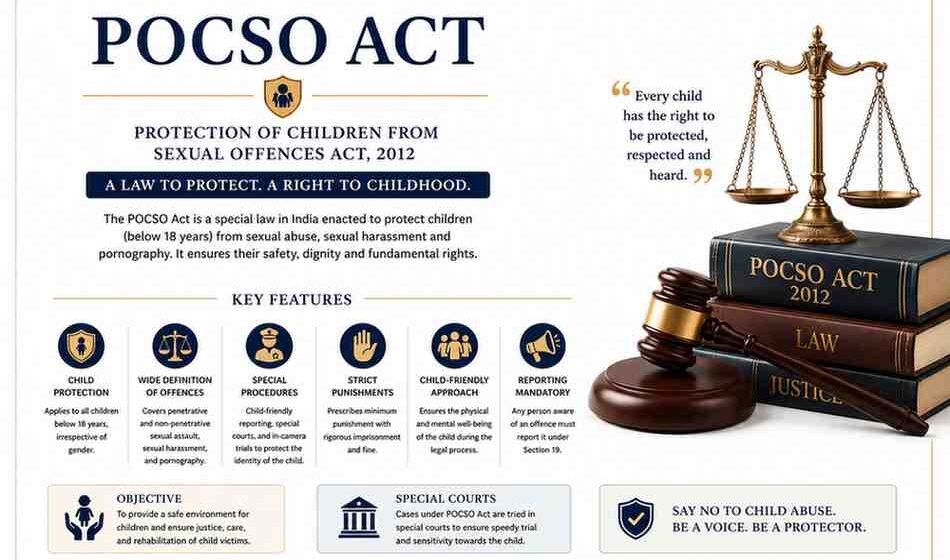
India’s ratification of the UN Convention on the Rights of the Child in 1992 added pressure to create stronger safeguards. After consultations and drafting, the POCSO Act was passed by Parliament in 2012 and came into force on November 14—Children’s Day. Administered by the Ministry of Women and Child Development, it was designed as a comprehensive, gender-neutral law covering all children under 18 years, regardless of gender.
This wasn’t just another law on paper. It marked a cultural and legal shift: recognizing that children deserve special protection because of their age, dependency, and inability to fully consent or protect themselves.
Provisions That Make It Powerful
At its core, POCSO defines a range of sexual offences with clarity that earlier laws lacked. Here’s a straightforward look:
- Penetrative Sexual Assault (Section 3): Any penetration (even minimal) with a body part or object, or making the child do so. Punishable with 10 years to life imprisonment (minimum 20 years if the child is under 16).
- Aggravated Penetrative Sexual Assault (Section 5): When committed by a person in a position of trust (like a teacher, police officer, or family member), against a disabled child, or in certain other circumstances. This carries rigorous imprisonment of 20 years to life, or even death penalty post-2019 amendments, especially for victims under 12 or in aggravated cases.
- Sexual Assault (non-penetrative, Section 7) and Aggravated versions: Touching private parts with sexual intent or making the child touch the offender. Minimum 3-5 years for basic, higher for aggravated.
- Sexual Harassment (Section 11): Words, gestures, showing pornography, or threats. Up to 3 years.
- Using Child for Pornography (Section 13-15): Producing, distributing, or possessing child sexual abuse material (CSAM). Strict penalties, including enhanced ones if linked to other assaults. The 2019 amendment broadened this to cover digital and computer-generated images.
All offences are cognizable (police can arrest without warrant) and non-bailable. Mandatory reporting is a standout feature—anyone with knowledge or reasonable apprehension of an offence must report it to police or the Special Juvenile Police Unit. Failure to do so (for adults) can lead to punishment under Section 21. Recent Supreme Court rulings have clarified that credible information from the victim counts as “knowledge.”
The Act emphasizes child-friendly procedures:
- Trials in Special Courts (to be completed within a year ideally).
- In-camera proceedings.
- Protection of the child’s identity by media and others.
- Appointment of support persons.
- Sensitivity in medical exams and interviews.
The 2019 Amendments
Public outrage over horrific cases led to key changes in 2019:
- Death penalty for aggravated penetrative assault on children below 12.
- Increased minimum sentences.
- Stronger anti-pornography measures, including penalties for mere possession or failure to report/delete CSAM.
- Coverage for assaults during natural calamities or similar situations.
These updates aimed to send a strong message: such crimes will not be tolerated.
Significance of the Act
POCSO’s biggest contribution is its child-centric approach. Unlike adult-focused laws, it prioritizes the child’s best interests, dignity, and recovery. It treats every child under 18 uniformly, closing gaps where older teens might have been treated as adults in consent matters.
It has boosted reporting dramatically. NCRB data shows tens of thousands of cases annually—67,809 in 2024 alone—many involving adolescents aged 12-18, with the vast majority of perpetrators being known to the victim (friends, relatives, acquaintances).
This rise in numbers isn’t necessarily just more abuse; it reflects greater awareness and willingnes s to come forward. Initiatives like NCPCR’s POCSO e-Box, toll-free helplines (1098), and awareness campaigns have played a role. Fast-track Special Courts have helped dispose of cases faster in some regions.
Legally, it aligns India better with international standards and has influenced judgments emphasizing mandatory reporting and victim support. It has empowered NGOs, schools, and communities to act as first responders.
Real-World Effects: Wins, Statistics, and Human Stories
On the positive side, POCSO has led to quicker police action in many cases and higher visibility of the issue. Convictions, though not ideal, have occurred, and the law has deterred some potential offenders through its stringent provisions.
However, the data tells a mixed story. While reporting has increased (up significantly over years), conviction rates hover around 30-35% in many analyses—lower than desirable. Pendency remains high, with thousands of cases backlog due to judicial delays, forensic bottlenecks, and witness issues.
Most victims know their abusers—over 96% in recent years—which complicates family and social dynamics. Cases involving “romantic” relationships among teens have sparked debates about age of consent, leading to some acquittals and calls for review.
For survivors, the law offers a path to justice, but the process can be re-traumatizing without proper support. Psychological care, rehabilitation, and compensation mechanisms need strengthening.
Challenges in Implementation: Where the Gaps Hurt Most
Despite its strengths, POCSO struggles on the ground:
- Low Awareness: Many in rural and tribal areas still don’t know the law fully.
- Infrastructure Shortfalls: Not enough Special Courts, trained judges, prosecutors, or support persons everywhere.
- Delays and Low Convictions: Cases often drag beyond the one-year target. Poor evidence collection and hostile witnesses contribute.
- Societal Stigma: Families hesitate to report due to shame, fear of ostracism, or pressure when the accused is known.
- False Complaints: Though punishable, concerns about misuse exist, particularly in teen relationships.
- Resource Gaps: Limited counseling, medical facilities, and rehabilitation for victims.
Under-reporting remains a huge issue; experts believe actual incidents far exceed registered cases. Coordination between police, judiciary, child welfare committees, and NGOs is often patchy.
The Role of POCSO in Modern India
POCSO isn’t just a punitive law—it’s part of a broader ecosystem including the Juvenile Justice Act, NCPCR oversight, and schemes like Beti Bachao Beti Padhao. It has pushed states to designate more courts and improve monitoring.
In the digital age, it tackles online grooming and CSAM effectively, though enforcement against tech platforms needs more teeth. Recent Supreme Court interventions on reporting obligations and victim support guidelines show the judiciary’s active role in plugging gaps.
Its gender-neutral stance protects boys too, an often-overlooked aspect, with rising recognition of male victims in data.
Looking Ahead: Strengthening the Shield
To make POCSO more effective:
- Ramp up training for police, teachers, doctors, and judicial officers.
- Expand Fast-Track Courts and ensure timely forensic support.
- Integrate mental health services for victims and families.
- Launch widespread, age-appropriate awareness programs in schools.
- Improve data tracking and inter-agency coordination.
- Balance stringent laws with sensitivity to avoid misuse, especially in consensual teen cases.
- Focus on prevention: addressing root causes like poverty, lack of supervision, and harmful gender norms.
Technology can help—better portals for complaints, AI for CSAM detection, and digital training modules.
A Law That Demands Our Collective Vigilance
The POCSO Act stands as a powerful statement: India will not turn a blind eye to the sexual exploitation of its children. It has saved lives, punished perpetrators, and shifted mindsets. But laws alone don’t protect—they need society, institutions, and consistent action behind them.
Every unreported case, every delayed trial, and every child left without support is a failure we must address. Parents, educators, policymakers, and citizens all have a role. By strengthening implementation, increasing awareness, and fostering a culture of zero tolerance, India can move closer to the safe childhood every child deserves.
As we reflect on over a decade of POCSO, the question isn’t just about the law’s existence—it’s about whether we, as a nation, are truly living up to its promise. The children of today are watching, and their future depends on how seriously we take their protection.



[…] fully appreciate this judgment, understanding the specific provisions of the POCSO Act is […]