
1. Introduction — What Is Judicial Review?
If you think about it, any government can pass a law. But should every law that gets passed be automatically valid? What if Parliament tomorrow passes a law saying people cannot criticize the government? Should that law stand just because a majority voted for it? This is exactly where Judicial Review steps in — and this is why it is one of the most powerful tools in the hands of the Indian judiciary.
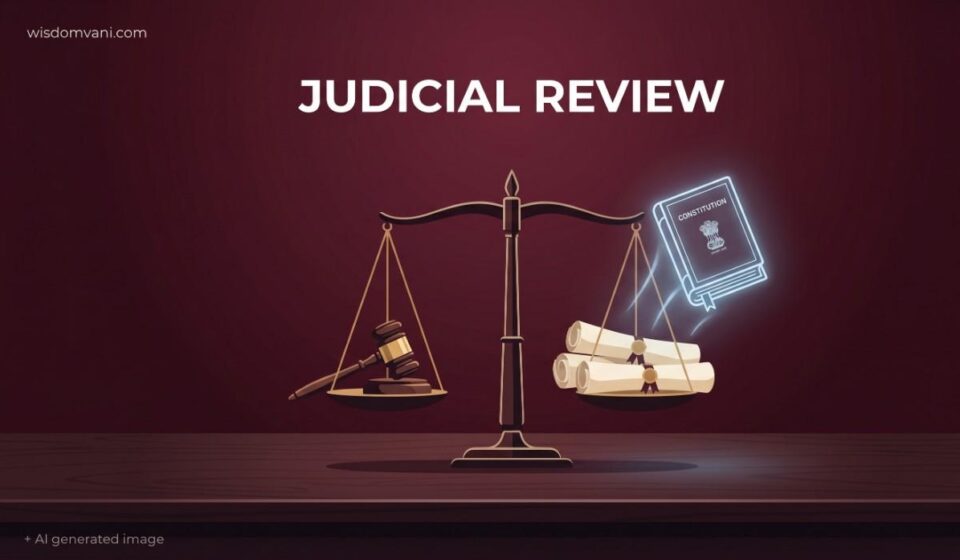
Judicial Review, in simple terms, is the power of the courts — especially the Supreme Court and High Courts — to examine laws passed by the legislature and actions taken by the executive, and to declare them void if they go against the Constitution. It is like a constitutional quality check. If a law fails the test, it gets struck down, no matter who passed it.
In India, judicial review is not just a judicial practice — it is a constitutional necessity. The Constitution of India is the supreme law of the land. Every organ of the state — Parliament, State Legislatures, the Central Government, State Governments — must function within the four corners of the Constitution. The moment they step outside, the courts can intervene.
2. Constitutional Basis of Judicial Review
India does not have a single provision that expressly says ‘judicial review is guaranteed.’ Instead, judicial review flows from several provisions of the Constitution read together. Let us look at them:
2.1 Article 13 — Laws Inconsistent with Fundamental Rights
This is the most direct provision. Article 13(1) says that all laws in force before the Constitution came into effect, to the extent they are inconsistent with Fundamental Rights, shall be void. Article 13(2) goes further and says the State shall not make any law that takes away or abridges Fundamental Rights, and any law made in contravention thereof shall be void.
Article 13(3) defines ‘law’ very broadly — it includes ordinances, orders, bye-laws, rules, regulations, notifications, and customs. So practically every state action that has the force of law is covered.
2.2 Article 32 — The Right to Constitutional Remedies
Dr. B.R. Ambedkar called Article 32 the ‘heart and soul of the Constitution.’ It gives every citizen the right to move the Supreme Court directly when their Fundamental Rights are violated. The Supreme Court has the power to issue writs — Habeas Corpus, Mandamus, Prohibition, Certiorari, and Quo Warranto — to enforce these rights.
2.3 Article 226 — Writ Jurisdiction of High Courts
Article 226 gives High Courts similar but broader writ powers. Unlike Article 32 which is limited to enforcement of Fundamental Rights, Article 226 allows High Courts to issue writs for ‘any other purpose’ as well. This means High Courts can review administrative actions that may not even involve Fundamental Rights.
2.4 Articles 131–136 — Appellate and Original Jurisdiction
Article 131 gives the Supreme Court original jurisdiction in disputes between states or between the Centre and states. Articles 132–136 give it appellate jurisdiction over High Court decisions. Through these provisions, the Supreme Court exercises wide powers of review over judicial and quasi-judicial decisions.
2.5 The Basic Structure Doctrine
Even the Constitution itself cannot be amended in a manner that destroys its ‘basic structure.’ This was established by the Supreme Court in Kesavananda Bharati v. State of Kerala (1973). So, judicial review extends even to constitutional amendments — a truly remarkable feature of Indian constitutionalism.
3. Scope of Judicial Review — What Can Be Reviewed?
3.1 Legislative Action
Courts can examine whether laws passed by Parliament or State Legislatures comply with the Constitution. The key questions are: Does this law fall within the legislative competence of the body that passed it? Does it violate any Fundamental Right? Does it violate any other constitutional provision?
3.2 Executive / Administrative Action
Administrative actions — orders, decisions, policies — are also subject to review. The courts examine whether the action was authorized by law, whether the authority acted within its powers (intra vires), whether proper procedure was followed, and whether the action was arbitrary or unreasonable.
3.3 Constitutional Amendments
After Kesavananda Bharati (1973), even constitutional amendments can be challenged on the ground that they damage or destroy the basic structure of the Constitution. This is unique to India — most democracies do not allow courts to strike down constitutional amendments.
3.4 What Is NOT Covered
Judicial review does not extend to purely political questions. Courts generally do not review the internal working of Parliament (like the conduct of debates), decisions of the President or Governor on matters committed to their discretion by the Constitution, or questions that are non-justiciable by nature.
4. Grounds on Which Courts Can Review
Over the decades, Indian courts have developed specific grounds on which an action or law can be challenged. The major ones are:
4.1 Violation of Fundamental Rights
This is the most common ground. If a law or state action violates Articles 14 (Right to Equality), 19 (Freedom of Speech, Movement, etc.), 21 (Right to Life and Liberty), or any other Fundamental Right, it can be struck down. The courts have interpreted these rights very expansively over time.
4.2 Lack of Legislative Competence
India has a federal structure. Parliament can legislate on subjects in List I (Union List) of the Seventh Schedule, and State Legislatures can legislate on subjects in List II (State List). If Parliament passes a law on a State List subject or vice versa without constitutional authority, that law is outside legislative competence and can be struck down.
4.3 Violation of Constitutional Provisions
Beyond Fundamental Rights, laws must also comply with other constitutional provisions — like the directive principles (which cannot override Fundamental Rights), procedural requirements for money bills, etc.
4.4 Unreasonableness and Arbitrariness
Under Article 14, the State cannot act arbitrarily. The Supreme Court has held that arbitrariness itself is a form of discrimination. If an action has no rational basis or is disproportionate, it can be struck down on the ground of arbitrariness.
4.5 Procedural Irregularity
Even if a law or action is otherwise valid, if the procedure prescribed was not followed — like not giving a fair hearing, not following principles of natural justice, or not issuing proper notices — courts can intervene.
5. Judicial Review vs. Judicial Activism — Where Is the Line?
Students often confuse judicial review with judicial activism. Let us clear this up. Judicial review is the formal constitutional power of the courts to examine the validity of laws and actions. Judicial activism is how courts use this power — sometimes more aggressively than the text of the law might suggest.
When courts interpreted Article 21 to include the right to food, the right to shelter, the right to education, the right to health, and dozens of other rights never explicitly mentioned in the text — that was judicial activism. When courts issued directions to governments on how to run their policies, manage their finances, or draft legislation — that was also activism.
There is genuine debate about whether courts sometimes cross the line from reviewing laws to making laws. Judges are not elected. If they start deciding policy questions — like how much budget should go to education or what should be the exact reservation policy — is that appropriate? This debate between judicial restraint and judicial activism is one of the most fascinating in Indian constitutional law.
6. Public Interest Litigation — Judicial Review for the Common Person
One of the most distinctive contributions of Indian judiciary is the Public Interest Litigation (PIL). Traditionally, only the person directly affected by a law or action could challenge it. But in India, the Supreme Court relaxed the rule of locus standi in the late 1970s and early 1980s.
Now, any person acting in public interest can file a PIL challenging a law or executive action, even if they are personally not affected. This has democratized judicial review enormously. Cases on bonded labour, child labour, environment protection, prison conditions, rights of undertrial prisoners, and election reforms have all come through PILs.
Justice P.N. Bhagwati and Justice V.R. Krishna Iyer were the pioneers of PIL in India. Cases like Hussainara Khatoon v. State of Bihar (1979) — which highlighted the plight of undertrial prisoners languishing in jails — were watershed moments in making judicial review accessible to ordinary citizens.
7. Limitations and Criticism of Judicial Review
No doctrine is perfect, and judicial review is no exception. Here are some genuine criticisms and limitations:
7.1 Counter-Majoritarian Concern
Courts are not elected bodies. When they strike down laws passed by elected Parliaments, there is a concern about unelected judges overriding the democratic will. In a democracy, who should have the final say — the people’s elected representatives or appointed judges?
7.2 Judicial Overreach
Sometimes courts go beyond reviewing laws and start making policy decisions — directing governments on how to conduct elections, manage the environment, regulate economic activities. Critics argue this is beyond the role assigned to courts under the Constitution.
7.3 Delays
The sheer volume of litigation in India means that challenges to laws and government actions can remain pending for years. A law that should be struck down quickly might remain operative for a decade before the matter is finally decided.
7.4 Inconsistency
Different benches of the Supreme Court have sometimes taken inconsistent positions on the same constitutional issue, creating uncertainty. The evolution of the basic structure doctrine itself shows how dramatically judicial views can change over time.
8. Why Judicial Review Matters — Its True Significance
Despite its limitations, judicial review remains the most important safeguard of constitutional democracy in India. Here is why it matters more than ever:
First, it protects the rights of minorities. A democratic majority can sometimes oppress minorities — religious, linguistic, social, or sexual. Judicial review ensures that the rights guaranteed to all citizens cannot be taken away just because a majority votes for it.
Second, it maintains the federal balance. India is a federal state. Judicial review ensures that the Centre does not encroach upon states’ powers and vice versa, maintaining the constitutional distribution of power.
Third, it preserves constitutional supremacy. Without judicial review, the Constitution would be just a document. Judicial review gives it life and enforceability.
Fourth, it has expanded rights dramatically. Many rights we take for granted today — right to livelihood, right to education, right to privacy, right to a clean environment — were not explicitly in the Constitution but were read into Article 21 through judicial review.
9. Conclusion
Judicial review is not just a legal concept you learn for your exams. It is the living, breathing mechanism through which the Indian Constitution remains relevant and effective. Every time a citizen’s right is protected against an arbitrary government action, every time an unjust law is struck down, every time the courts remind the state that power has limits — that is judicial review at work.
As law students, you should not just memorize the provisions and cases. You should understand why this power exists, how it has evolved, and what its future should look like. The debate between judicial restraint and judicial activism, between protecting rights and respecting democracy, is one that will continue for as long as India remains a constitutional republic.
And honestly, that is what makes constitutional law so exciting — it is not static. Every new government policy, every new challenge to individual rights, every new social issue is ultimately filtered through the lens of judicial review. As future lawyers, advocates, and perhaps judges, you will be part of this ongoing conversation.