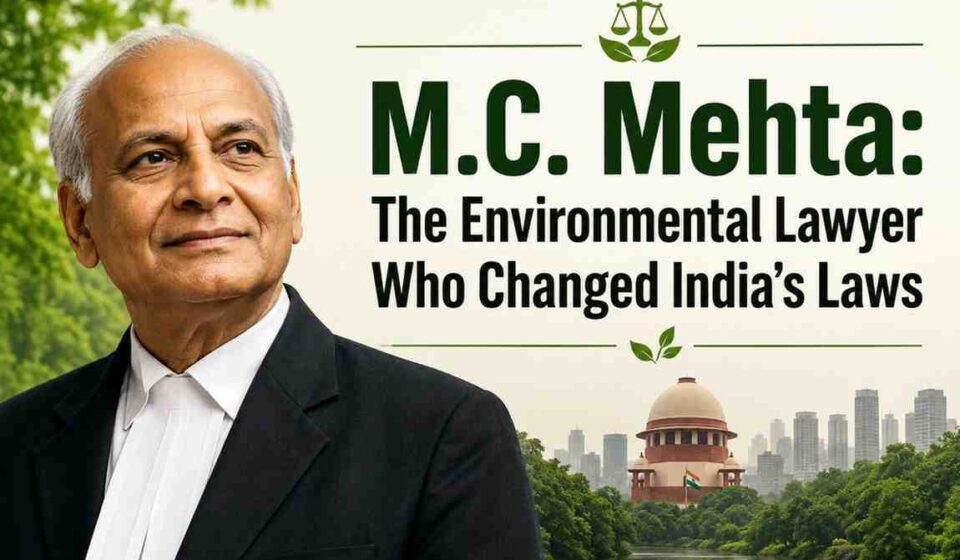

Imagine standing before the Taj Mahal on a clear day, only to notice its once-pristine white marble slowly turning yellow. For most visitors, it might be a passing disappointment. For lawyer Mahesh Chandra Mehta, it became a lifelong calling. Often called the “Green Avenger” or “Green Crusader,” M.C. Mehta has spent decades fighting powerful industries, reluctant governments, and systemic pollution through the courts—and winning. Since the mid-1980s, this soft-spoken advocate has secured over 40 landmark Supreme Court judgments that have reshaped India’s environmental laws and protected millions of lives.
In an era when environmental concerns often feel overwhelming, Mehta’s story offers both hope and a roadmap. He showed that one determined individual, armed with the law and persistence, can force change at the highest levels. This blog explores his remarkable journey, key battles, and the lasting legacy that continues to inspire lawyers, activists, and citizens today.
The Lone Warrior Who Took On Industries
Mahesh Chandra Mehta didn’t set out to become India’s most celebrated environmental lawyer. Born in a modest family in Rajasthan, he built a conventional legal practice before a chance visit to the Taj Mahal in 1984 changed everything. What he saw there—the iconic monument discolored by industrial fumes—ignited a fire that would define his career.
Mehta isn’t a flashy courtroom performer. Colleagues describe him as methodical, deeply committed, and remarkably persistent. What sets him apart is his willingness to take on seemingly impossible fights against powerful corporations and government apathy. While many lawyers handle one or two big cases, Mehta has almost single-handedly driven environmental jurisprudence in India for four decades. His work has touched everything from river pollution to vehicular emissions, proving that the courtroom can be one of the most effective tools for conservation.
The Turning Point: A Yellowing Taj Mahal
Mehta’s first major environmental case stemmed directly from that 1984 visit. Disturbed by the visible damage to the Taj Mahal caused by nearby industries, he decided to act. He filed petitions that eventually culminated in the landmark M.C. Mehta v. Union of India (1996), often called the Taj Trapezium Case.
The Supreme Court ruled in his favor, ordering the relocation or closure of hundreds of polluting units around the monument. It established the Taj Trapezium Zone—a protected area where strict emission norms apply. This wasn’t just about saving a tourist attraction. It set a precedent for protecting cultural heritage from industrial harm and showed that economic development couldn’t come at the cost of irreplaceable national treasures.
This case marked the beginning of Mehta’s “lone warrior” phase. He didn’t have a large team or massive funding. Instead, he relied on meticulous research, public interest litigation (PIL), and an unwavering belief in the Constitution’s promise of a dignified life.
Major Legal Battles That Changed India
Mehta’s contributions go far beyond one monument. Here are some of his most impactful cases, explained simply:
Cleaning the Ganga One of Mehta’s longest-running crusades has been against the pollution of India’s holiest river. Through multiple petitions, he forced authorities to address industrial effluents and untreated sewage flowing into the Ganges. The Supreme Court ordered the setting up of sewage treatment plants and directed industries to install pollution control devices. While challenges remain, his efforts brought national attention to the Ganga’s plight and established accountability mechanisms that later cases built upon.
Vehicular Pollution and Cleaner Fuel Mehta took on Delhi’s toxic air long before it became a global headline. His petitions led to landmark orders requiring the conversion of public transport to compressed natural gas (CNG) and the introduction of lead-free petrol. These changes dramatically improved air quality in the capital and influenced similar reforms across the country. He effectively linked the right to breathe clean air with the constitutional right to life.
Expanding the Right to Life (Article 21) Perhaps Mehta’s greatest legal legacy is how he helped broaden Article 21—the right to life and personal liberty. Through his cases, the Supreme Court recognized that this right includes the right to a clean environment, clean water, and healthy living conditions. He bridged the gap between environmental protection and fundamental rights, making pollution not just a regulatory issue but a constitutional violation.
His litigation also reinforced other constitutional provisions. Article 48A directs the state to protect and improve the environment, while Article 51A(g) makes it a fundamental duty of citizens to do the same. Mehta’s arguments wove these together, creating a robust framework for environmental justice.
Mehta has tackled issues like industrial waste in the Yamuna, hazardous chemical leaks, and the protection of forests and wildlife. In the Oleum Gas Leak case, his efforts contributed to the principle of absolute liability—holding industries strictly accountable for accidents involving dangerous substances, regardless of negligence.
The Power of Public Interest Litigation (PIL)
A big reason for Mehta’s success is his masterful use of PIL. This tool, pioneered in the late 1970s, allows any public-spirited citizen to approach the courts for matters affecting the larger public. Mehta turned PIL into a powerful weapon for the environment when traditional litigation would have been too slow or expensive.
He often filed cases based on newspaper reports or personal observations, prompting the court to appoint expert committees and monitor implementation. This “continuing mandamus” approach—where courts keep oversight—ensured that judgments didn’t gather dust. His work made environmental law accessible and demonstrated that ordinary citizens could hold the powerful accountable.
The M.C. Mehta Environmental Foundation
Recognizing that one person can’t do it all, Mehta established the M.C. Mehta Environmental Foundation. This organization trains young lawyers, conducts research, runs awareness campaigns, and continues litigation on emerging issues. It ensures his methods and values are passed on to the next generation of environmental defenders.
The foundation also works on ground-level projects—community education, river clean-ups, and policy advocacy—showing that legal victories must be supported by societal change.
Recognition for a Lifetime of Service
Mehta’s work hasn’t gone unnoticed. He received the Goldman Environmental Prize in 1996 (often called the “Green Nobel”), the Ramon Magsaysay Award in 1997 for public service, and the Padma Shri in 2016. These honors highlight not just his legal wins but his role as a moral voice for the environment.
Despite the accolades, Mehta remains humble. He continues practicing law, often taking up cases pro bono and mentoring young advocates.
Bridging Constitutional Provisions
But, what makes Mehta’s strategy brilliant is how he connected different parts of the Constitution. Article 21 (Right to Life) was expanded to include environmental rights. He reminded the state of its duty under Article 48A and urged citizens to fulfill theirs under Article 51A(g). This holistic approach turned environmental cases into constitutional matters, giving them higher priority and stronger enforcement. It’s a masterclass in creative yet grounded legal argumentation.
Why Mehta’s Work Still Matters Today
In 2026, India faces new environmental challenges—plastic waste, groundwater depletion, extreme weather, and rapid urbanization. Mehta’s cases provide the legal foundation to tackle them. His emphasis on accountability and citizen participation is more relevant than ever in the fight against climate change.
His journey shows that change is possible even against heavy odds. Industries may be powerful, but the law, when wielded with integrity, can level the playing field.
What Can We Do?
M.C. Mehta’s story isn’t just about one man’s achievements. It’s an invitation for all of us to engage. Here’s how you can contribute:
- Learn about your environmental rights and duties.
- Support organizations working on clean air, water, and biodiversity.
- Participate in local clean-up drives or awareness campaigns.
- If you’re a law student or young lawyer, consider environmental law as a career path—there’s immense scope for impact.
- Hold governments and corporations accountable through informed voting and civic action.
A cleaner, greener India won’t happen overnight. But as Mehta has shown, persistent, principled effort can move mountains—or at least protect them from destruction.
The “Green Crusader” continues his work, a quiet reminder that the fight for a sustainable future is far from over. In his footsteps, a new generation of lawyers and activists is rising.