
Picture this. You are scrolling through an online store and you hit “Buy Now” on a new laptop. You instantly regret it. Can you stop the order? What if the seller already packed it? What if they already shipped it?
In the offline world, imagine sending a formal letter offering to sell your bike. Before the buyer replies, you find a better buyer. Can you pull your offer back?
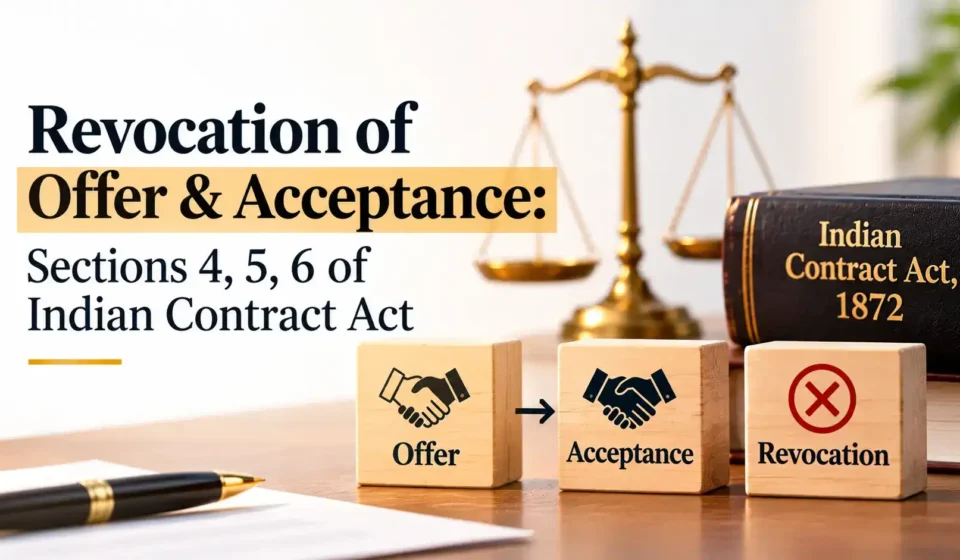
Every day, people and businesses find themselves in these exact situations. Here the concept of revocation (revocation) is work in contract law. The Indian Contract Act, 1872 – especially in Section 4, 5 and 6 – explicit rules on how, when and why a proposal (offer) or acceptance can be cancelled.
If you are a law student, this topic is a staple in your exams. But even if you aren’t, knowing these rules saves you from getting stuck in bad deals. Let’s break it down piece by piece, without the heavy legal jargon.
The Foundation: When Does Communication Actually “Finish”? (Section 4)
You cannot revoke something unless you know when the other person officially has it. Section 4 is all about the timeline. It decides when the law considers a message to be “complete.”
Here is how the law views it:
The Offer: It is complete when the person you are offering it to actually reads or hears it.
The Acceptance (for the person offering): It is complete the moment the other person sends the acceptance out of their control. For example, the moment they drop the letter in the mailbox, or hit “send” on an email.
The Acceptance (for the person accepting): It is complete only when the person who made the offer actually receives it.
The Revocation: If you are cancelling an offer, it is complete when the other person actually gets to know about it.
Why this matters for students: Think of this as a game of tennis. Once the ball leaves your racket, you can’t take it back. The moment the acceptor puts their acceptance in transit, the clock starts ticking. You need to memorize these timelines because they decide who has the legal power.
Section 5: The “Window of Time” to Revoke
Section 5 gives you the actual right to back out. But it comes with strict deadlines.
Revoking an Offer: You can pull back your offer at any time, as long as the other person hasn’t already sent their acceptance. Once they post that acceptance, your offer is locked. You can’t back out.
Revoking an Acceptance: If you accepted an offer, you can still cancel your acceptance, as long as your acceptance hasn’t reached the original offer-maker yet.
The Classic Race Scenario
Let’s say A offers to sell his car to B for ₹5 lakhs via a letter. B writes back saying “I accept” and posts the letter on Monday. It will reach A on Thursday.
A can change his mind and revoke the offer until Monday (when B posts the letter). But on Tuesday, A cannot revoke it.
On the flip side, B can revoke his acceptance. How? B sends a faster message (maybe an email) on Tuesday saying, “I changed my mind, I don’t want the car.” If the email reaches A on Wednesday—before the physical letter arrives—B has successfully revoked his acceptance. No contract is formed.
This is known as the Postal Rule. It is a favorite question in university exams, so make sure you understand that the proposer’s window closes when the acceptance is posted, while the acceptor’s window closes when the acceptance is received.
Section 6: The Four Ways a Proposal Dies
Section 6 tells us exactly how an offer comes to an end. If you are wondering how revocation of an order actually happens in real life, it usually falls into one of these four buckets:
1. Revocation by Notice
This is the most direct way. You simply tell the other person, “I take my offer back.”
The Rule: You don’t need a special format. An email, a phone call, or even a WhatsApp message works. But the notice must reach them before they accept. If you send a notice, but they accept the offer before your notice arrives, a valid contract is formed. You are too late.
2. Revocation by Lapse of Time
Offers don’t last forever.
Fixed Time: If your offer says, “This offer is valid for 7 days,” it automatically dies on the 8th day. You don’t need to send a notice.
Reasonable Time: If you didn’t mention a deadline, the law implies a “reasonable time.” What is reasonable? It depends on the item. An offer to sell fresh fruit expires in days. An offer to sell land might stay open for weeks. If the time lapses, the offer is dead.
3. Revocation by Failure of a Condition
Sometimes an offer has a “if-then” clause. “I will sell you my shop, if you get a bank loan approved by Friday.” If Friday passes and the buyer doesn’t have the loan, the offer automatically stands revoked. You don’t need to argue about it.
4. Revocation by Death or Insanity
This is a grim but practical rule. If the person who made the offer dies or becomes mentally unsound, the offer dies with them.
The Catch: The person accepting the offer must know about the death or insanity. If they accept the offer in good faith, without knowing the offer-maker passed away, their acceptance is still legally valid.
What About “Irrevocable” Offers?
Here is a tricky area where students often get confused. Can you make an offer that you cannot revoke?
Generally, no. Under Indian law, a promise to keep an offer open is not enforceable on its own. If I say, “I promise to keep this offer open for a month,” I can still revoke it tomorrow. The other person can’t sue me for breaking that promise, because they didn’t give me anything in return for it (no consideration).
But there is an exception: The Option Contract. If the buyer pays the seller a small amount of money just to keep the offer open (say, ₹10,000 to hold a ₹50 lakh property deal for a month), the offer becomes irrevocable. The seller cannot back out during that month.
Recent Case Laws: How Courts Are Applying These Rules Today
Law is not just about reading the Act; it’s about seeing how courts interpret it. Here is what the judiciary has been saying recently (2024–2026):
State of Himachal Pradesh v. OASYS Cybernatics (Supreme Court, 2025)
This case involved a Letter of Intent (LoI) given during a government tender process. The state cancelled the LoI, and the contractor argued that it was a binding contract.
The Court’s Ruling: The Supreme Court called an LoI a “promise in embryo.” It means the contract is still in the womb; it hasn’t been born yet. Unless all conditions of the tender are fully met and the formal contract is signed, the government (or any party) retains the right to revoke the LoI in the public interest.
Student Takeaway: An LoI is not a free pass to start the work. It is just a preliminary step and remains revocable.
Guarantees and Powers of Attorney
What if you revoke something, but the other party ignores it? In a 2025 NCLAT decision, a personal guarantor tried to revoke his guarantee to a bank. But the bank didn’t accept the revocation, and the guarantee contract made it irrevocable. The tribunal held the guarantor liable anyway.
Similarly, the Jammu & Kashmir High Court in 2026 ruled on Powers of Attorney (PoA). If a PoA is given for consideration (like someone paid you to act as their agent), the principal cannot just unilaterally revoke it to cheat the agent.
Practical Tips for Law Students
If you want to master this topic for exams or for your future practice, remember these points:
Always read the clock. The difference between a valid contract and a failed one often comes down to an hour or a day. Understand the exact moment communication is complete.
Keep evidence of revocation. Always use a trackable mode of communication. If you call someone to revoke an offer, follow it up with an email. You need to prove they “had knowledge” of the revocation.
Differentiate between an Offer and a Contract. You can revoke an offer easily (before acceptance). But once a contract is formed, you can’t “revoke” it. You can only “terminate” it based on the terms of the contract or the law.
Don’t confuse an Invitation to Offer with an Offer. A menu at a restaurant is an invitation to offer. You making an order is the offer. The restaurant cooking the food is the acceptance. If you change your mind, you can revoke your order before the chef starts cooking!
The Conclusion
The law of ‘revocation’ (return or cancellation) is an excellent blend of strict legal rules and practical understanding. Sections 4, 5 and 6 of the ‘Indian Contract Act’ give you a clear guideline. These streams tell that the law respects the freedom to change your own thoughts, but at the same time it also respects the trust that the other party has done on your things.
Whether you’re cancelling an online order, withdrawing job offers, or preparing a big corporate tender – at what time your decision is taken, that’s everything decided. Understand these streams well, know the ‘Postal Rule’ (postal Rules), and keep an eye on the recently-in-course decisions. This is the easiest way to bring good marks in the exams and keep yourself safe in real life.