

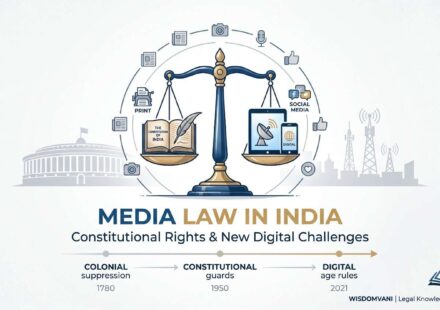
Evolution of Media and Media Law in India: Colonial to Digital Era

Media is often described as the fourth pillar of Indian democracy. It plays a crucial role in informing citizens, exposing wrongdoing, and ensuring accountability of those in power. The journey of media and the laws governing it in India reflects a shift…

Freedom of Speech and Expression: Article 19(1)(a) and Reasonable Restrictions
1. Introduction Think about this for a moment. Without the freedom to speak, how would you protest a government policy you believe is unjust? Without the freedom to write, how would journalists expose corruption? Without the freedom to express, how…
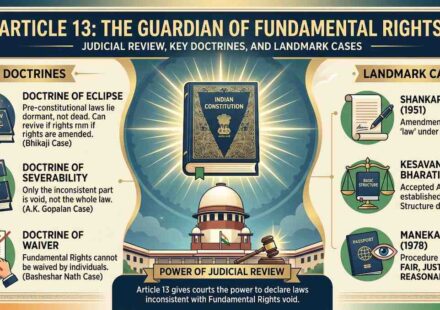
Article 13 of the Indian Constitution: Shield of Fundamental Rights & Judicial Review
1. Introduction — A Small Article with an Enormous Job Somewhere in the very beginning of Part III of the Constitution of India — the chapter that houses our Fundamental Rights — sits Article 13. It is not the most dramatic article. It does not declare…

Indian Partnership Act 1932: Definitions, Elements, and Types
1. Introduction The Indian Partnership Act, 1932 governs partnerships in India. It was enacted to consolidate and amend the law relating to partnership and came into force on 1 October 1932. Understanding the Act — its definitions, the essential elements…

The Dowry Prohibition Act 1961: A Comprehensive Legal Guide
1. Introduction Imagine a young woman, educated and capable, whose marriage becomes a commercial transaction. Her family is pressured to give cash, gold, appliances, and vehicles — not as a gift of love, but as a demand backed by threat. If the demand is…

Rights of Surety & Discharge: Indian Contract Act Guide
1. INTRODUCTION The law of guarantee occupies a distinct space in Indian contract jurisprudence. Unlike ordinary bilateral contracts, a contract of guarantee is inherently tripartite. It involves three parties: the principal debtor, the creditor, and the…

The Doctrine of Frustration (Section 56): Indian Contract Act Explained
1. Introduction — When Life Upends a Contract Two parties enter a contract in good faith. They agree on the terms, fix the price, and plan everything carefully. Then something happens — something nobody could have anticipated or controlled. A war breaks…
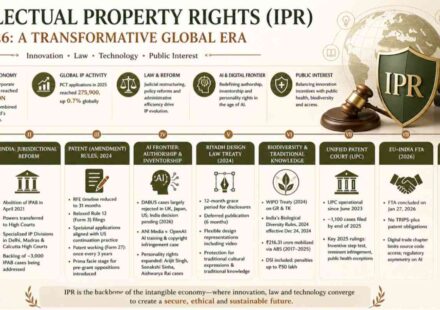
Strategic IPR Reconfiguration: Global & Indian Legal Developments
The global landscape of intellectual property rights (IPR) has undergone a foundational metamorphosis between 2021 and 2026. This period marks the definitive transition from a framework centered on physical industrial outputs to one anchored in…

The Karta in Hindu Law: Powers, Liabilities, and Female Kartaship
1. Introduction — The Manager of a Family Empire Picture a large joint family — a grandfather, his sons, their wives, and their children, all living together and sharing property, income, and responsibilities. Who makes the big decisions? Who represents…
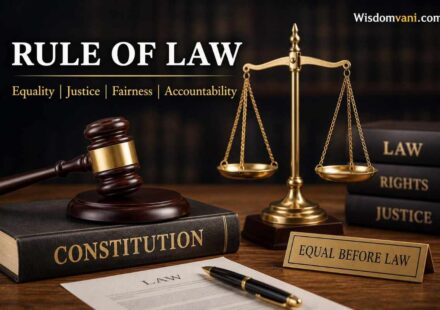
Rule of Law: Meaning, Dicey’s Theory, and Constitutional Importance in India
1. Introduction — No One Is Above the Law Let us start with a simple but powerful image. A police officer arrests a citizen without any lawful authority, beats them in custody, and walks away — because nobody dares challenge a person in uniform. A…