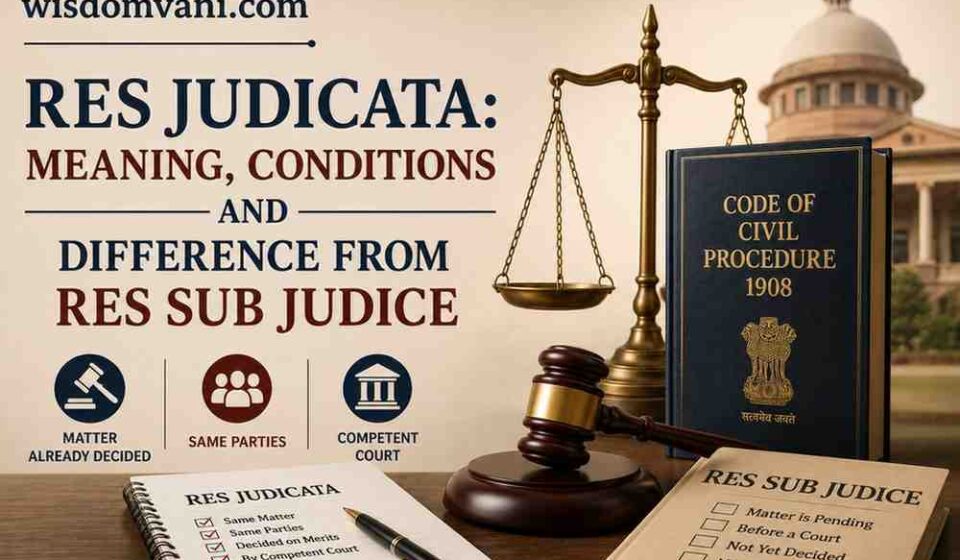

Picture a property dispute between two brothers that a civil court has already decided, with a clear judgment on who owns what. A few years later, one of the brothers, unhappy with the outcome, files a fresh suit over the very same property, hoping for a different result from a different judge. Should the court entertain this second round of litigation? Indian civil procedure answers that question with a firm no, and the doctrine responsible for that answer is res judicata.
This article explains what res judicata actually means, where it comes from in the Code of Civil Procedure, 1908, what conditions must be met before a court can apply it, and how it differs from a closely related rule that students and even practising lawyers often mix up — res sub judice. By the end, the distinction between the two should be clear enough that you will never confuse them again.
What Does Res Judicata Mean?
The phrase comes from Latin. “Res” means a thing, subject matter, or dispute, and “judicata” means already judged or decided. Put together, res judicata simply means “a matter already decided.” Once a competent court has heard a dispute and given a final decision on it, the same parties cannot bring the very same dispute back to court and ask for a second opinion.
This idea is not unique to Indian law. Ancient Hindu legal texts referred to a similar concept as “purva nyaya,” meaning a former judgment, and Roman law followed the principle that one dispute deserved only one decision. India inherited a refined, codified version of this idea through the common law tradition, and it now lives in Section 11 of the Code of Civil Procedure, 1908.
The Philosophy Behind the Doctrine
Three Latin maxims are usually cited to explain why this rule exists, and each captures a slightly different reason.
The first, nemo debet bis vexari pro una et eadem causa, means that no person should be troubled twice for the same cause. Litigation is expensive, stressful, and time-consuming, and the law does not want a losing party to be dragged back to court again and again over an issue that has already been settled.
The second, interest reipublicae ut sit finis litium, reflects the idea that the state itself has an interest in seeing disputes come to an end. Courts have limited time and resources, and allowing the same matter to be litigated endlessly would clog the system and prevent genuinely new disputes from being heard promptly.
The third, res judicata pro veritate accipitur, simply means that a judicial decision must be accepted as correct once it becomes final. Even if a decision later turns out to be debatable, the law gives it the weight of truth between the parties involved, because allowing constant reopening of settled matters would undermine public confidence in the courts altogether.
Section 11 of the Civil Procedure Code
Section 11 lays down the rule in fairly precise language: no court can try any suit or issue where the matter directly and substantially in question has already been directly and substantially decided in an earlier suit between the same parties, or between people claiming under the same title, by a court that was competent to try the later suit as well, and where that earlier decision has become final.
That is a dense sentence, so it helps to break it into the individual conditions that must all be satisfied together.
Essential Conditions for Res Judicata to Apply
For a court to apply res judicata and refuse to hear a case again, the following requirements generally need to be met.
First, the matter in the new suit must be the same matter — directly and substantially — that was in question in the earlier suit. Minor or incidental overlaps are not enough; the core issue has to be identical.
Second, the parties in both suits must be the same, or they must be people litigating under the same title as the original parties, such as legal heirs or assignees. If a person appears in the second suit in a completely different capacity, the bar does not apply.
Third, the parties must have litigated under the same title in both proceedings. Even where the same property is involved, if the right being claimed is fundamentally different in nature, courts have held that res judicata will not apply, since the focus here is on the underlying right being asserted, not merely the subject matter.
Fourth, the earlier suit must have been decided by a court that was competent to try the subsequent suit as well. Explanation II to Section 11 clarifies that this competence is judged independently of any right of appeal — what matters is whether the issue was heard and finally decided, not whether someone could have appealed it.
Fifth, the issue must have been heard and finally decided on its merits, not dismissed on a technical ground such as a limitation defect or a procedural lapse. If the earlier suit was dismissed because of something like an unpaid court fee, that dismissal does not amount to a decision on the actual dispute, so res judicata does not kick in.
Sixth, the earlier decision must be final, meaning either no appeal was filed against it, or any appeal that was filed has already been resolved.
Constructive Res Judicata
One of the most interesting extensions of this principle comes from Explanation IV to Section 11, which introduces what lawyers call constructive res judicata. This explanation says that any plea which could and should have been raised in the earlier suit, but was not, is treated as though it had actually been raised and decided.
The logic here is straightforward: a party is expected to bring their entire case before the court at one go. If someone deliberately holds back an argument, hoping to use it as ammunition for a future round of litigation, the law refuses to allow that. Constructive res judicata stops a party from sitting on a plea and dragging out disputes in instalments, which would defeat the entire purpose of the doctrine.
Difference Between Res Judicata and Res Sub Judice
This is where a lot of confusion creeps in, especially for someone newer to civil procedure, because both rules sit right next to each other in the Code and both aim to stop multiple proceedings over the same matter. The key is to remember the timing: res sub judice, found in Section 10 of the CPC, deals with a matter that is still pending before a court, while res judicata, under Section 11, deals with a matter that has already been finally decided.
| Point of Comparison | Res Sub Judice (Section 10, CPC) | Res Judicata (Section 11, CPC) |
|---|---|---|
| Stage of the dispute | The earlier suit is still pending and undecided | The earlier suit has already reached a final decision |
| What it does | Stays or pauses the trial of the second suit until the first one is resolved | Bars the second suit altogether; it cannot be tried at all |
| Underlying idea | Prevents two courts from deciding the same matter simultaneously and risking conflicting outcomes | Prevents the same matter from being litigated a second time after it has already been settled |
| Effect on the suit | Temporary — the second suit can resume once the first is decided | Permanent — the second suit is dismissed and cannot proceed |
| Applies between | The same parties, over substantially the same matter, where both suits are filed in courts having jurisdiction to grant the relief claimed | The same parties or their privies, where the earlier decision was given by a competent court |
| Common analogy | Think of it as pressing “pause” on the new case | Think of it as pressing “stop” on the new case permanently |
So, in short: res sub judice asks the question “is this matter already being heard somewhere else?”, and if the answer is yes, it puts the new suit on hold. Res judicata asks a different question altogether — “has this matter already been decided?” — and if the answer is yes, it shuts the door on the new suit completely.
How Res Judicata Differs From Estoppel
Another comparison that often comes up in the same breath is the difference between res judicata and estoppel, since both prevent a person from going back on something. The distinction, though, is fairly clean once you see it laid out. Res judicata binds the court itself — it removes the court’s jurisdiction to even hear the matter again. Estoppel, on the other hand, binds the parties, preventing one of them from taking a position in court that contradicts an earlier representation they made. Res judicata is essentially a procedural bar created by a judicial decision, while estoppel is more evidentiary in character, growing out of a party’s own conduct, statement, or admission rather than out of a court’s judgment.
Where Does Res Judicata Apply Beyond Ordinary Civil Suits?
While Section 11 speaks specifically about “suits,” courts have long recognised that the general principle behind res judicata is broader than its statutory wording and extends well beyond regular civil litigation. It has been applied to execution proceedings, interim orders, and even writ petitions filed under the Constitution.
The most well-known illustration of this is Daryao v. State of Uttar Pradesh (1961), where the Supreme Court held that if a writ petition filed before a High Court under Article 226 is dismissed on its merits, the same petitioner cannot file a fresh writ petition before the Supreme Court under Article 32 seeking the identical relief on the same grounds. The Court reasoned that allowing such a second attempt would defeat the very purpose behind the rule of finality.
In Satyadhyan Ghosal v. Deorajin Debi, the Supreme Court explained the doctrine in plain terms: once a matter, whether of fact or law, has been finally decided between two parties in one proceeding, neither party can be permitted to argue the same point all over again in a later proceeding between them.
Exceptions Where Res Judicata Does Not Apply
The doctrine, despite its strict tone, is not absolute. A few well-recognised exceptions exist.
If the earlier judgment was obtained through fraud or collusion between the parties, it loses its binding force and cannot operate as res judicata in later proceedings. Similarly, if the court that delivered the earlier judgment lacked proper jurisdiction over the subject matter, that decision cannot create a valid bar, since a court without jurisdiction has no real authority to decide the matter in the first place.
The doctrine also does not extend to a writ of habeas corpus, given the urgency and personal liberty interests involved in such petitions. Where genuinely new evidence comes to light — evidence that could not have been discovered earlier despite reasonable diligence — courts have shown a willingness to allow the issue to be examined afresh. And where the suit was abandoned or withdrawn by the plaintiff under Order 23 Rule 1, rather than being decided on its merits, res judicata does not apply either, since nothing was actually “adjudged” in such a case.
Why This Doctrine Matters in Practice
For lawyers and litigants alike, res judicata is far more than an academic concept tucked away in a procedural code. It is regularly raised as a preliminary objection in fresh suits, often deciding the fate of a case before the actual merits are even examined. A party invoking the doctrine must specifically plead it and place the earlier judgment before the court, since courts do not apply it on their own initiative without being informed of the previous proceeding. Once successfully established, however, it acts as a complete bar, closing the door on litigation that has already run its course.
Conclusion
Res judicata exists to give litigation a sense of closure. Without it, the same dispute could be recycled through court after court indefinitely, draining both judicial resources and the patience of the parties involved. Understanding it properly also means understanding where it ends and where a related rule, res sub judice, begins — one deals with a matter still being heard, the other with a matter that has already been finally settled. Keeping that single distinction clear is often the easiest way to avoid mixing up two doctrines that, on the surface, can look deceptively similar.