

Essential Conditions and Ceremonies of Marriage under Hindu Marriage Act, 1955

1. Introduction — Marriage Is Not Just a Ceremony, It Is a Legal Institution If you ask most people what a marriage is, they will describe a ceremony — a mandap, a priest, vows, flowers, music, and a celebration that lasts for days. And they would not be…

Criminology Explained: Meaning, Nature, Scope and Importance
1. Introduction — Why Should a Law Student Care About Criminology? Imagine you are standing in a courtroom, defending a young man accused of theft. You can argue the law — section by section, precedent by precedent. But have you ever stopped to ask: why…
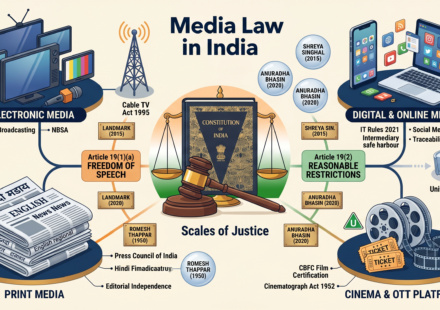
Types of Media Law in India: Constitution, Regulations & Landmark Cases
1. Introduction — Media and the Law: Why Does It Matter? Think about the last time you formed an opinion about a politician, a government scheme, or a social issue. How did that happen? Chances are, it was because of something you read, watched, or…
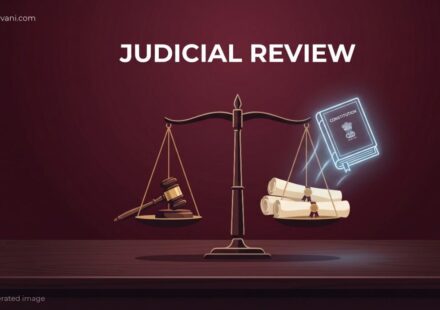
Judicial Review in India: Meaning, Scope & Landmark Cases
1. Introduction — What Is Judicial Review? If you think about it, any government can pass a law. But should every law that gets passed be automatically valid? What if Parliament tomorrow passes a law saying people cannot criticize the government? Should…
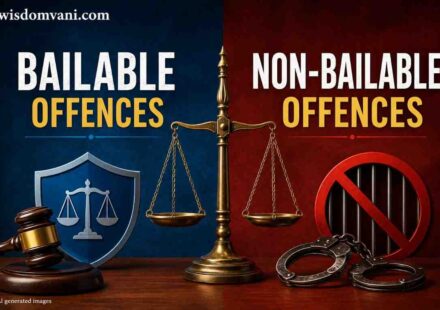
Bailable and Non-Bailable Offences Under Indian Criminal Law: A Complete Guide
If someone you know has been arrested, those two words — bailable or non-bailable — suddenly become the most important words in your life. They decide whether the person comes home the same day or stays in judicial custody for weeks or months. The good…

Hindu Adoptions and Maintenance Act, 1956: Nature, Essentials & Effects (Sections 6 to 16)
Adoption under Hindu law was once a deeply religious act, performed mainly so that a man would have a son to light his funeral pyre and carry forward his lineage. A daughter could rarely be adopted, a woman could almost never adopt in her own right, and…
Article 368 of the Indian Constitution: Procedure and Power of Parliament to Amend
The Indian Constitution is often described as a “living document,” a metaphorical designation that underscores its organic capacity to evolve alongside the socio-political and economic aspirations of the nation. At the heart of this…
Types of Punishment Under Bharatiya Nyaya Sanhita (BNS) — Section 4 Explained
When India replaced its old colonial-era criminal code in 2024, a lot of things changed. The Indian Penal Code, 1860 — a law written under British rule and running for over 160 years — was repealed and replaced by the Bharatiya Nyaya Sanhita, 2023 (BNS).…
BNS Section 2 Definitions Explained: Simple Guide for Law Students
Hey future lawyers and law students! If you’ve just started studying the new criminal laws in India, you’ve probably seen the Bharatiya Nyaya Sanhita (BNS), 2023 mentioned everywhere. It replaced the old Indian Penal Code (IPC) from 1 July 2024. One…
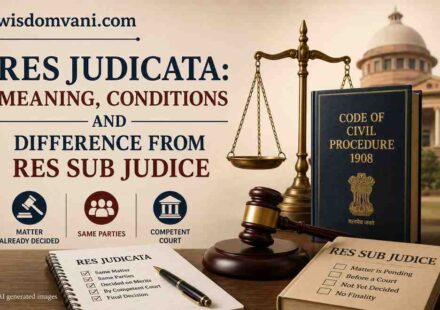
Doctrine of Res Judicata: Meaning, Conditions, and Its Difference from Res Sub Judice
Picture a property dispute between two brothers that a civil court has already decided, with a clear judgment on who owns what. A few years later, one of the brothers, unhappy with the outcome, files a fresh suit over the very same property, hoping for a…