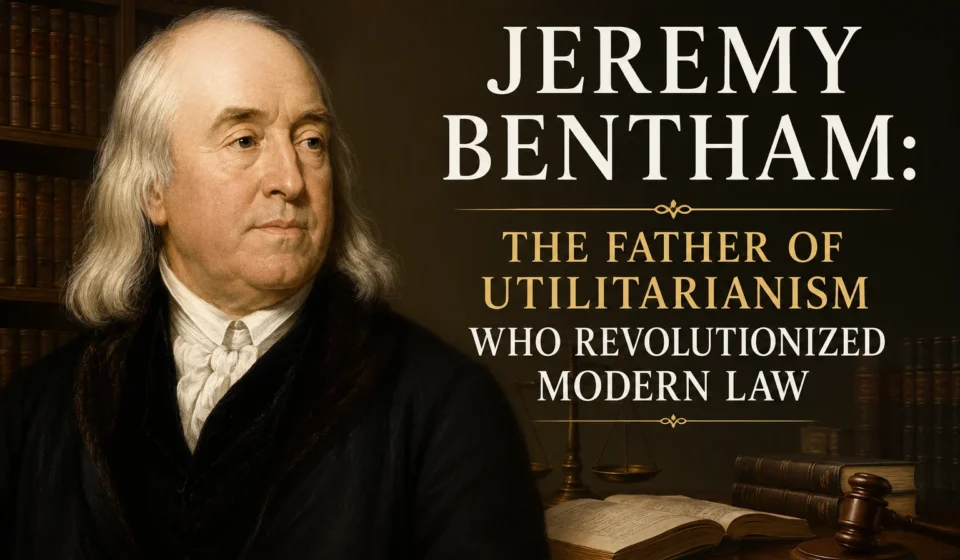

What if the entire purpose of law wasn’t just to punish wrongdoers, but to create the greatest happiness for the greatest number of people? That bold idea didn’t come from a politician or a philosopher locked in an ivory tower. It came from Jeremy Bentham, a brilliant and eccentric thinker whose ideas still shape how we understand justice, governance, and society today.
Often called the “Father of Utilitarianism,” Bentham was a revolutionary force in the 18th and 19th centuries. He challenged outdated legal systems rooted in tradition, religion, and harsh punishments, pushing instead for laws based on reason, evidence, and human welfare. His influence stretches from prison reform to international law, and even to modern debates on public policy and human rights. In this blog, we’ll explore Bentham’s life, his groundbreaking philosophy, and why his work remains incredibly relevant in our complex world.
Who Was Jeremy Bentham?
Born in 1748 in London, Jeremy Bentham grew up in a world where England’s legal system felt stuck in the past. Laws were often cruel, inconsistent, and influenced more by custom than logic. As a child prodigy, Bentham entered Oxford at just 12 years old. He trained as a lawyer but quickly became disillusioned with the profession, calling it full of “fallacies” and unnecessary complexity.
Instead of practicing law in the traditional sense, Bentham devoted his life to critiquing and reforming it. He believed that every action, law, or policy should be judged by one simple test: Does it promote happiness and reduce suffering? This principle—“the greatest happiness of the greatest number”—became the foundation of his philosophy, known as utilitarianism.
Bentham wasn’t just a thinker in isolation. He corresponded with leaders across Europe and America, influenced reformers, and wrote extensively on topics ranging from economics to animal rights. His ideas were radical for the time. He supported women’s rights, opposed slavery, and even advocated for decriminalizing homosexuality—positions far ahead of mainstream society.
The Core Philosophy: Greatest Happiness for the Greatest Number
At the heart of Bentham’s thought is utilitarianism. In simple terms, it says that the moral worth of any action is determined by its outcome—specifically, how much net happiness it creates for the largest number of people.
He famously argued that “nature has placed mankind under the governance of two sovereign masters, pain and pleasure.” Laws, according to Bentham, should aim to maximize pleasure and minimize pain across society. This was a shift from earlier views that saw law as divine command or rigid tradition.
Bentham applied this to legislation. He wanted laws to be clear, codified, and designed with empirical evidence rather than abstract morality. This approach laid the groundwork for legal positivism—the idea that law is what is enacted by humans, separate from what it “ought” to be morally. It influenced later thinkers like John Stuart Mill, who refined utilitarianism further.
His philosophy wasn’t without critics. Some argued it could justify harming minorities for the “greater good.” Others said it reduced human life to cold calculations. Yet Bentham’s focus on measurable outcomes pushed societies toward evidence-based policy—a principle we still value in public health, economics, and welfare programs today.
Major Legal Contributions
Bentham didn’t stop at theory. He actively pushed for practical reforms that transformed legal systems.
Prison Reform and the Panopticon One of his most famous (and controversial) ideas was the Panopticon—a prison design where inmates could be observed at all times without knowing when they were being watched. The goal was efficient management and rehabilitation rather than pure punishment. While the full design was never built in his lifetime, it influenced modern surveillance and prison architecture. More importantly, Bentham advocated for humane treatment, education for prisoners, and reducing the brutality of the penal system.
Codification of Law Bentham criticized the common law system for being chaotic and judge-made. He pushed for comprehensive legal codes that were accessible to ordinary people. This idea influenced many countries’ civil law traditions and efforts to simplify statutes.
International Law Pioneer Bentham is credited with coining the term “international law.” He envisioned rules governing relations between nations based on utility and mutual benefit, laying early foundations for global institutions and human rights frameworks.
Influence on Legal Positivism By separating law from morality (“what the law is” versus “what the law ought to be”), Bentham helped create a more scientific approach to jurisprudence. This distinction remains fundamental in legal education and practice.
His relentless writing and lobbying gradually shifted public and political opinion toward rational reform. Many of his ideas found expression in 19th-century British legislative changes, from poor laws to criminal justice.
Why Bentham’s Ideas Still Matter in the Modern World
Fast forward to today, and Bentham’s utilitarian lens is everywhere. Governments routinely use cost-benefit analysis for policies on healthcare, education, and environmental regulation—asking which option brings the most good to the most people.
In democracies, public opinion polls, welfare economics, and social impact assessments all echo his thinking. During the COVID-19 pandemic, debates over lockdowns, vaccines, and resource allocation often boiled down to utilitarian calculations: protecting the greatest number while minimizing overall harm.
On human rights, Bentham’s focus on reducing suffering helped pave the way for modern frameworks. While he was sometimes skeptical of abstract “natural rights,” his emphasis on happiness and well-being influenced documents like the Universal Declaration of Human Rights. His ideas remind us that rights aren’t just theoretical—they should deliver real improvements in people’s lives.
In environmental law and corporate governance, we see utilitarian principles in sustainability reporting and impact investing. Companies and regulators increasingly ask: Does this decision maximize long-term well-being for society?
An Interesting Fact
Bentham left behind one of the most unusual legacies in history. In his will, he requested that his body be preserved as an “Auto-Icon”—a dressed skeleton with a wax head, seated in a chair. You can still visit it today at University College London, where it attends board meetings (reportedly with a vote in case of a tie).
This eccentric request wasn’t just a quirk. Bentham wanted to demonstrate the value of using bodies for scientific study and to remain “useful” even after death—perfectly in line with his utilitarian philosophy.
Conclusion
Jeremy Bentham was far more than a philosopher. He was a reformer who believed law could—and should—serve human happiness. His push for reason over tradition, evidence over dogma, and outcomes over rituals helped drag legal systems into the modern age.
As we face 21st-century challenges like climate change, inequality, and technological disruption, Bentham’s core question remains powerful: Are our laws and policies truly creating the greatest happiness for the greatest number?
What do you think? Does today’s legal system prioritize collective well-being, or does it sometimes get lost in formalities and special interests? Share your thoughts in the comments below. If this blog sparked your interest in legal philosophy or reform, explore Bentham’s writings or support organizations working on evidence-based policy.
The “Father of Utilitarianism” may have lived over 200 years ago, but his ideas continue to challenge and guide us toward a fairer, more rational world.